
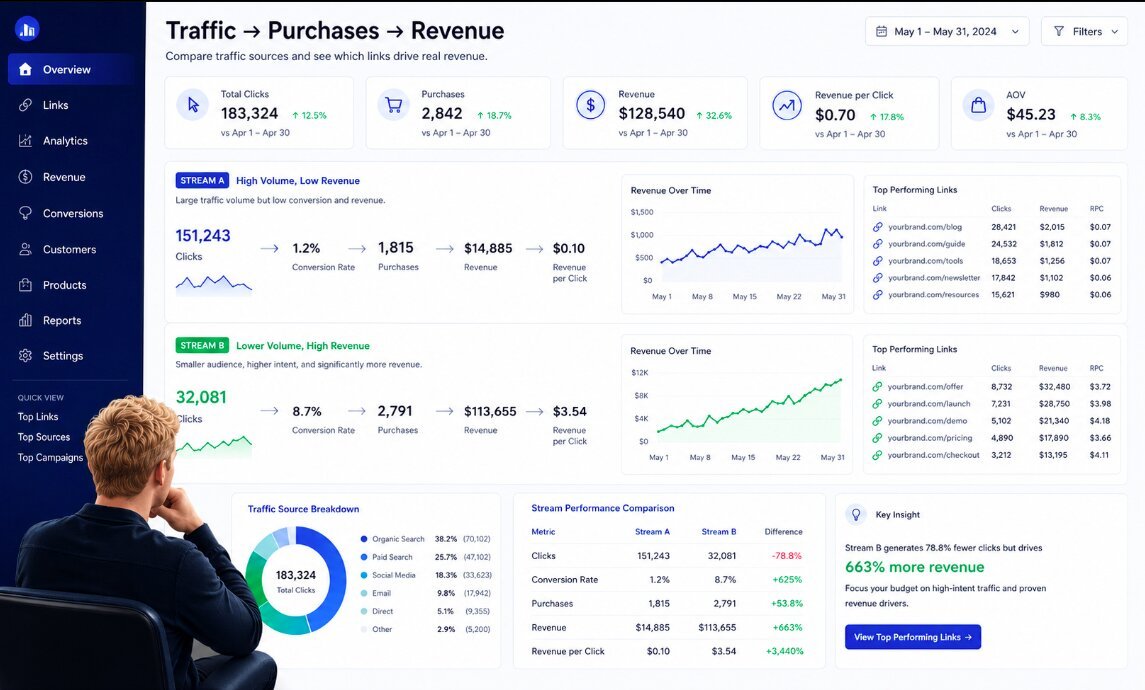
Earnings Per Click looks like a simple way to understand ecommerce performance. More revenue from fewer clicks sounds like a win.
But here is the problem: a strong EPC number does not always mean you are getting profitable customers. It can hide which links, audiences, and channels are actually driving sustainable revenue.
Many ecommerce brands optimize for the click. The smarter brands optimize for what happens after the click.
Why Your Ecommerce Store's Earnings Per Click Can Be Misleading
EPC is commonly used to measure how efficiently traffic generates earnings.
It can help answer:
- How much revenue came from clicks?
- Which campaigns appear efficient?
- Which traffic sources generate sales?
That sounds useful. And it is.
But EPC can create blind spots when it becomes the only number you trust.
A high EPC does not automatically tell you:
- Which customers have the highest lifetime value
- Which links create repeat buyers
- Which channels deserve more investment
- Whether revenue came from profitable traffic
- Which marketing actions created the purchase
A small number of expensive orders can inflate EPC.
For example:
A paid ad sends 100 visitors and generates two $500 purchases.
Another campaign sends 5,000 visitors and creates 100 smaller purchases.
The first campaign may have a higher EPC, but the second may be building a stronger customer base.
The problem is not EPC itself. The problem is using a single metric without understanding the full revenue journey.
This is where ecommerce revenue attribution becomes important.
EPC vs RPC: The Difference Between Click Value and Revenue Quality
The biggest mistake brands make is assuming every click has equal value.
It does not.
Revenue Per Click (RPC) focuses on connecting tracked clicks directly to business revenue.
The formula is:
Revenue ÷ Clicks = Revenue Per Click
For example:
Traffic Source A
- 1,000 clicks
- $1,000 revenue
RPC = $1.00
Traffic Source B
- 5,000 clicks
- $2,000 revenue
RPC = $0.40
At first glance, Source B looks better because it generated more traffic.
But Source A produced more revenue from each visitor.
That tells you something important:
The smaller traffic source may be the better growth opportunity.
This is why RPC is becoming a stronger ecommerce performance metric. It focuses less on traffic volume and more on traffic quality.
A thousand clicks from buyers are worth more than ten thousand clicks from people who never purchase.
How a Store Can Misread Its Best Traffic Source
Imagine an ecommerce brand selling premium skincare products.
The marketing team reviews monthly performance.
Instagram looks impressive:
- High reach
- Thousands of clicks
- Strong engagement
- Lots of comments
The team assumes Instagram is the winner.
But after connecting link tracking analytics to revenue data, they discover something different.
The email newsletter generated:
- Fewer clicks
- Smaller audience
- Higher purchase intent
- More revenue per visitor
The newsletter was not creating more attention.
It was creating more customers.
Another example:
A creator with 500,000 followers posts about a product.
The post gets attention but produces limited sales.
A smaller creator with 8,000 followers creates a detailed product review.
The smaller creator drives fewer visitors but more purchases.
Why?
Because audience size is not the same as buyer quality.
The best traffic source is not always the biggest one. It is the one that creates valuable customers.
How to Find Your Real Revenue-Driving Traffic
Track Every Important Store Link
Most ecommerce brands track campaigns.
Fewer track the individual links that create sales.
Every important customer entry point should be measurable:
- Product links
- Influencer campaigns
- Email campaigns
- Paid ads
- Social posts
- Affiliate links
A campaign-level view tells you where traffic came from.
A link-level view tells you what actually created revenue.
That difference matters when deciding where to spend more money.
Connect Clicks to Purchases
The ideal customer journey looks like this:
Customer clicks a link →
Visits your store →
Views a product →
Purchases →
Revenue is attributed back to the source
Without this connection, brands are guessing.
They may know:
- How many people visited
- How many people clicked
- How many sales happened
But they do not know which marketing actions created those sales.
That creates wasted spending.
Measure Profitability, Not Just Activity
Many ecommerce dashboards are built around activity:
- Sessions
- Clicks
- Views
- Engagement
These numbers are useful, but they are not the final goal.
The business goal is revenue.
Better questions are:
- Which links create the highest revenue?
- Which audiences buy more?
- Which campaigns create repeat customers?
- Which channels deserve more budget?
A channel with fewer clicks can still be your strongest acquisition source.
Shift Budget Toward Winners
Revenue-focused optimization follows a simple process:
- Identify high-value traffic sources
- Reduce investment in weak channels
- Scale profitable links and campaigns
- Continue testing new opportunities
The goal is not to eliminate every underperforming experiment.
The goal is to stop funding channels that only create activity.
More clicks do not automatically mean more growth. Better clicks do.
Ecommerce Metrics Comparison: EPC vs Revenue-Focused Tracking
| Metric | What It Shows | What It Misses |
| Clicks | Traffic volume | Revenue quality |
| CTR | Interest | Customer value |
| EPC | Earnings efficiency | Full attribution picture |
| Conversion Rate | Buyer percentage | Revenue size |
| RPC | Revenue generated per click | Actual traffic value |
Stop Guessing Which Clicks Make Money
Ecommerce growth becomes easier when you know which actions actually create revenue.
Linkorio helps brands connect their links with revenue outcomes, making it easier to understand which campaigns, creators, and channels are driving real sales.
Instead of asking:
“Which link got the most clicks?”
you can ask:
“Which link created the most valuable customers?”
That is the difference between tracking activity and understanding performance.
Conclusion: Optimize for Valuable Clicks, Not More Clicks
Clicks are only the beginning of the customer journey.
A click matters because of what happens next.
The strongest ecommerce brands do not win by chasing more traffic. They win by understanding which traffic creates profitable customers.
The goal is not more clicks. The goal is knowing which clicks are worth more.
Revenue-focused tracking helps you build marketing decisions around business results instead of surface-level numbers.
Frequently Asked Questions
What does Earnings Per Click (EPC) mean in ecommerce?
Earnings Per Click measures how much revenue or earnings are generated from each click. It is commonly used in affiliate marketing and campaign analysis to understand traffic efficiency.
What is the difference between EPC and RPC?
EPC usually measures earnings generated from clicks, while Revenue Per Click (RPC) focuses on connecting tracked clicks directly to business revenue outcomes. RPC helps brands understand which traffic sources create real customer value.
Is a higher EPC always better?
No. A high EPC can be caused by a small number of large purchases. Brands should also consider customer quality, repeat purchases, and total revenue contribution.
Why is ecommerce link tracking important?
Ecommerce link tracking helps businesses identify which specific links, campaigns, creators, or channels generate sales instead of only measuring clicks or traffic.
How can brands track profitable traffic?
Brands can track profitable traffic by connecting marketing links to revenue data and measuring metrics like Revenue Per Click, customer value, and purchase behavior.