
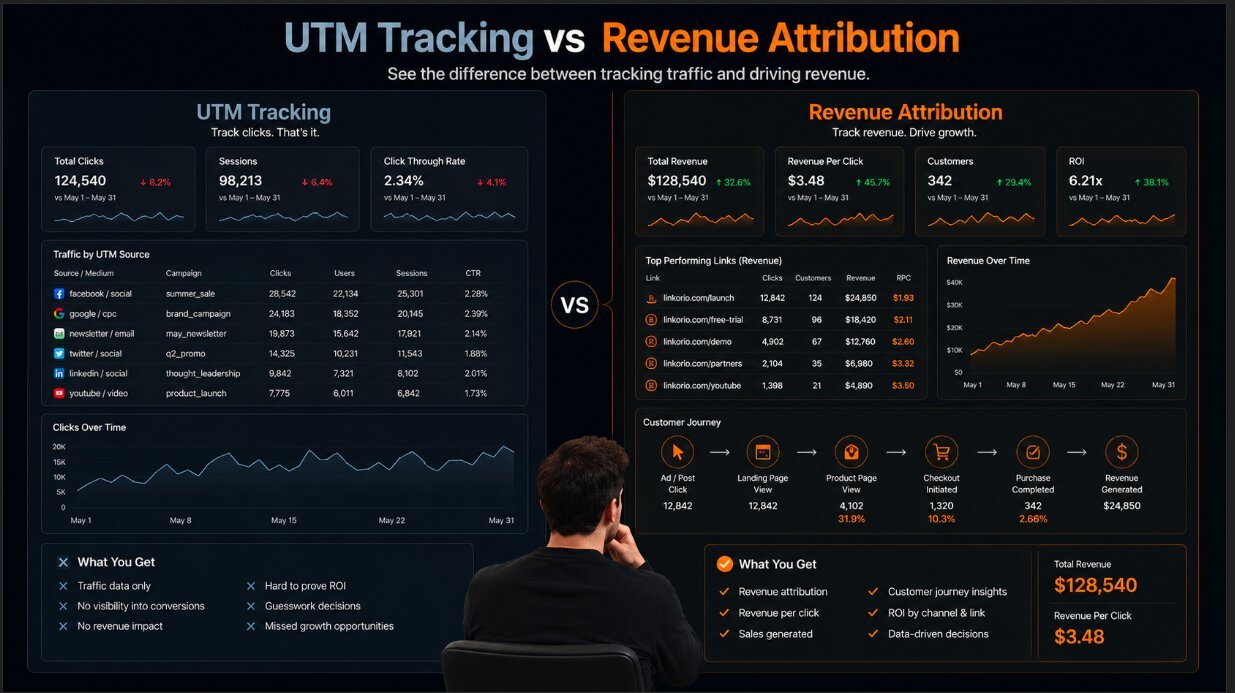
Most marketers think adding UTM parameters means they have solved attribution.
They haven't.
UTM parameters are useful. They tell you where traffic came from, which campaign sent a visitor, and how different channels perform.
But they usually stop before answering the question that matters most:
What actually created revenue?
That is the difference between UTM parameters vs revenue attribution.
One helps organize traffic data.
The other helps businesses understand which marketing efforts create customers.
For companies spending money on ads, content, partnerships, and campaigns, that difference changes how decisions get made.
Why UTM Tracking Alone Doesn't Tell the Full Story
UTM tracking became popular because it solved a real marketing problem.
Before UTMs, it was difficult to understand where visitors came from.
UTM parameters allow marketers to add information to links, such as:
- Source
- Medium
- Campaign
For example:
A company can track whether traffic came from:
- A LinkedIn campaign
- A newsletter
- A paid ad
- An affiliate partner
This helps organize marketing reporting.
It helps answer:
"Where did this visitor come from?"
That question matters.
But it is only part of the story.
The Attribution Gap
The problem starts when marketers try to connect traffic to revenue.
A UTM report might show:
"This campaign generated 10,000 visitors."
But it does not always answer:
- Which specific link created the sale?
- Which campaign generated the highest-value customers?
- Which content convinced someone to buy?
- Which traffic source deserves more budget?
A campaign can generate massive traffic and poor revenue.
Another can generate fewer visitors and create significantly more sales.
Without deeper attribution, both can look similar.
This is the problem with incomplete attribution.
You can see activity.
You cannot always see business impact.
UTM Parameters vs Revenue Attribution: What's the Difference?
The difference between UTM parameters vs revenue attribution comes down to the question being answered.
UTM parameters answer:
"Where did this visitor come from?"
Revenue attribution answers:
"What marketing action created revenue?"
Both are valuable.
They simply solve different problems.
UTM Tracking Shows Traffic Context
UTMs are useful for:
- Organizing campaigns
- Tracking channels
- Comparing traffic sources
- Understanding campaign structure
For example:
A marketer might discover that email generated more visitors than social media.
That is helpful.
But the next question is:
Did email generate more customers?
Did those customers spend more?
Were those clicks valuable?
Revenue Attribution Shows Business Impact
Revenue attribution connects marketing activity to outcomes.
Instead of stopping at:
"People clicked this link."
It asks:
"Those clicks produced these customers and this revenue."
That requires connecting:
Marketing link → Visitor → Customer → Revenue
This is where link-level tracking becomes important.
Why Revenue Per Click Goes Beyond Click Tracking
Clicks are easy to measure.
They are also easy to misunderstand.
A click represents interest.
It does not represent value.
That is why Revenue Per Click (RPC) is a more useful way to evaluate traffic quality.
The formula is:
Revenue ÷ Clicks = Revenue Per Click
RPC shows how much revenue each click generates.
Consider two campaigns.
Campaign A
- 20,000 clicks
- $1,000 revenue
Campaign B
- 2,000 clicks
- $4,000 revenue
A click-focused report would make Campaign A look stronger.
It has:
- More traffic
- More activity
- More visibility
But Campaign B is the better investment.
Why?
Because each click is worth more.
The traffic quality is higher.
The audience is more likely to become customers.
This is the difference between measuring attention and measuring business value.
How to Move From UTM Tracking to Revenue Attribution
UTMs should not be abandoned.
They are still useful.
The mistake is assuming they provide the full picture.
A stronger system combines campaign tracking with revenue data.
Use UTMs to Understand Traffic Sources
UTMs are valuable for organizing marketing activity.
They help answer:
- Which campaigns are sending visitors?
- Which channels are active?
- Which sources are driving traffic?
For many teams, this is the starting point.
But traffic is only the beginning.
A visitor does not pay because a UTM exists.
A customer pays because the marketing experience created enough value.
Add Link-Level Tracking
The next step is understanding which specific links drive results.
Examples include:
- Newsletter links
- Social posts
- Paid ads
- Affiliate links
- Landing pages
- Partner campaigns
A common mistake is grouping everything together.
For example:
A SaaS company runs three campaigns:
- A founder LinkedIn post
- A partner newsletter
- A paid search campaign
All send visitors to the same page.
The traffic is visible.
The revenue source is not.
Link-level attribution fixes this.
It shows which specific marketing assets create customers.
Measure Revenue, Not Just Campaign Activity
Marketing dashboards often focus on:
- Clicks
- Sessions
- Impressions
- Engagement
These numbers are useful for understanding reach.
They are weaker for deciding where money should go.
Revenue-focused measurement looks at:
- Revenue generated
- Revenue Per Click
- Customer value
- Conversion quality
The question changes from:
"Which campaign got attention?"
to:
"Which campaign created business results?"
That is a better optimization target.
Make Better Budget Decisions
Revenue attribution helps answer questions that basic reporting cannot.
For example:
Where should we spend more?
You invest in sources producing strong revenue.
Which campaigns should stop?
You remove campaigns producing activity without results.
Which channels create customers?
You double down on proven acquisition sources.
Better attribution does not just create better reports.
It creates better decisions.
UTM Tracking vs Revenue Attribution Comparison
| Metric | UTM Tracking | Revenue Attribution |
| Tracks traffic source | Yes | Yes |
| Tracks campaigns | Yes | Yes |
| Shows clicks | Yes | Yes |
| Shows revenue impact | Limited | Yes |
| Identifies profitable links | No | Yes |
| Helps allocate budget | Limited | Yes |
| Measures RPC | No | Yes |
The difference is simple:
UTMs explain where traffic came from.
Revenue attribution explains what traffic was worth.
Common Attribution Mistakes Businesses Make
Many companies collect more data but still struggle to make decisions.
Why?
Because they track activity instead of outcomes.
Common mistakes include:
- Optimizing campaigns based on clicks alone
- Assuming high traffic means high value
- Measuring engagement without revenue context
- Using one tracking link across multiple channels
- Ignoring which specific links create customers
More data does not automatically create better decisions.
Better attribution does.
Turn Your Links Into Revenue Data
Linkorio helps marketers connect clicks, links, and campaigns to actual revenue outcomes.
Instead of only seeing where visitors came from, teams can understand which marketing efforts create customers.
This makes it easier to identify:
- Profitable links
- High-value traffic sources
- Winning campaigns
- Better budget opportunities
The goal is not collecting more reports.
The goal is understanding what actually works.
Conclusion
UTMs help organize marketing data.
Revenue attribution helps make better business decisions.
Knowing where traffic came from is useful.
Knowing what that traffic was worth is much more powerful.
The goal is not simply knowing which campaigns generate clicks.
The goal is knowing which campaigns generate customers.
That is the shift from basic tracking to revenue-focused marketing.
Frequently Asked Questions
What are UTM parameters used for?
UTM parameters track information about where website traffic comes from, including source, medium, and campaign details.
Why are UTM parameters not enough for revenue attribution?
UTMs show traffic origins but do not always connect specific links and campaigns to actual revenue outcomes.
What is Revenue Per Click?
Revenue Per Click (RPC) measures the revenue generated from each click by dividing revenue by total clicks.
Can UTM tracking and revenue attribution work together?
Yes. UTMs provide traffic context, while revenue attribution adds the connection between marketing activity and revenue.
Why is link-level attribution important?
Link-level attribution shows which specific links, campaigns, and content pieces generate customers, helping businesses make better marketing decisions.
Does more traffic always mean better marketing performance?
No. A smaller traffic source with higher RPC can be more valuable than a larger source that creates little revenue.