
Most marketers are chasing the wrong number.
They celebrate traffic spikes, higher CTRs, and growing impressions while assuming more visitors automatically lead to more growth. The reality is harsher: a large percentage of website traffic creates zero business value.
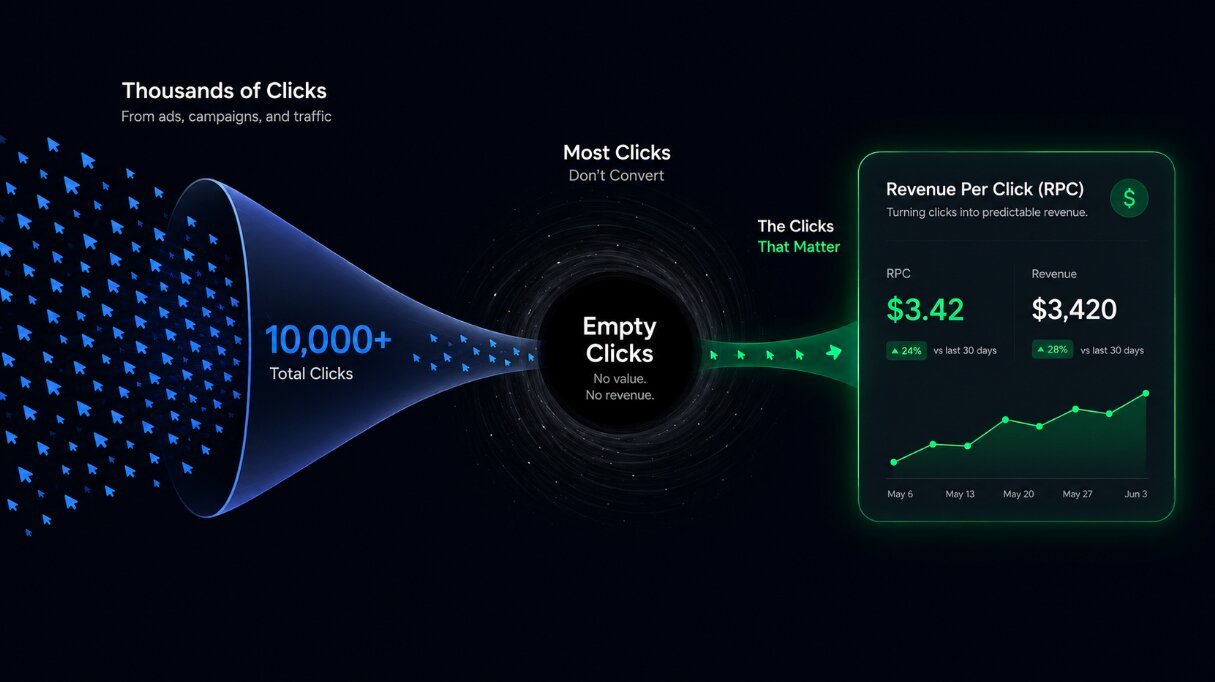
These are empty clicks—visits that consume budget, attention, and reporting space without generating revenue. If you're measuring success by traffic volume instead of outcomes, you could be scaling waste instead of growth.
Why Marketers Keep Falling for Vanity Metrics
Marketing dashboards are full of numbers that look impressive.
Traffic is up 40%.
CTR increased from 2% to 4%.
Impressions doubled.
Keyword rankings improved.
On paper, everything looks healthy.
The problem is that none of these metrics answer the only question that matters:
Did it make money?
This is where many founders, agencies, and growth teams get stuck. They mistake activity for progress.
Traffic reporting platforms make it easy to see visitors. Ad platforms make it easy to see clicks. SEO tools make it easy to see rankings.
What they don't make easy is understanding which traffic sources actually produce revenue.
That's how teams end up investing more money into campaigns that generate attention but not customers.
The Hidden Cost of Vanity Metrics
The danger of vanity metrics isn't that they're completely useless.
The danger is that they create a false sense of success.
A campaign can generate:
- High traffic
- Strong engagement
- Excellent click-through rates
- Thousands of visitors
And still produce almost no revenue.
When attribution is weak, these campaigns often survive because nobody can prove they're underperforming financially.
The result is a growing pile of empty clicks hiding inside otherwise positive-looking reports.
The Real Enemy: Empty Clicks and Poor Attribution
An empty click is simple:
A visitor who clicks but never contributes meaningful business value.
Not every visitor should become a customer. That's normal.
The problem begins when entire traffic sources consistently produce clicks without revenue.
Examples include:
- Viral social traffic with low buying intent
- Broad informational content attracting the wrong audience
- Low-quality referral traffic
- Display campaigns optimized for clicks instead of purchases
- Affiliate traffic focused on volume rather than conversions
Without proper revenue attribution, these sources often look successful because they generate activity.
In reality, they're consuming resources while profitable opportunities remain underfunded.
Many businesses don't have a traffic problem.
They have an attribution problem.
The Empty Click Trap
The Empty Click Trap happens when businesses optimize for click generation instead of revenue generation.
The pattern usually looks like this:
- A channel delivers large amounts of traffic.
- Reports show increasing clicks and visitors.
- Budgets get expanded.
- Revenue remains flat.
- Teams assume they need even more traffic.
The cycle repeats.
Meanwhile, a smaller traffic source generating actual buyers gets overlooked because its visitor numbers seem insignificant.
This is why traffic quality matters more than traffic volume.
Ten thousand visitors who never buy are less valuable than one hundred visitors who consistently purchase.
Yet most reporting systems emphasize volume first and revenue second.
Why Revenue Per Click Changes Everything
The metric that exposes the Empty Click Trap is Revenue Per Click (RPC).
Revenue Per Click measures how much revenue each click generates on average.
The formula is straightforward:
Revenue Per Click (RPC) = Total Revenue ÷ Total Clicks
Unlike CTR, RPC connects traffic directly to business outcomes.
CTR tells you whether someone clicked.
RPC tells you whether the click was worth anything.
A channel producing 1,000 clicks at $0.05 RPC generates $50 in revenue.
A channel producing 100 clicks at $5.00 RPC generates $500 in revenue.
Most teams instinctively focus on the first channel because it produces more traffic.
The second channel is actually ten times more valuable.
This is why one high-RPC traffic source can outperform thousands of low-quality visitors.
Revenue Attribution vs Traditional Traffic Reporting
Many analytics tools stop at traffic measurement.
They answer questions like:
- Where visitors came from
- Which pages they viewed
- How long they stayed
- What links they clicked
Useful information.
Incomplete information.
Google Analytics Traffic Reporting
Traditional analytics platforms are excellent for understanding behavior.
They're less effective at answering:
Which specific links generated revenue?
You may know a visitor came from organic search.
You may not know which article, link placement, campaign, or referral source produced the sale.
UTM-Only Tracking
UTMs help categorize traffic.
They're useful for campaign organization.
But UTMs alone don't solve attribution.
They identify sources.
They don't automatically reveal which links generate the highest Revenue Per Click.
Bitly and Traditional Link Shorteners
Most link shorteners focus on click measurement.
They show:
- Click counts
- Geographic data
- Device information
- Referral sources
Again, useful.
But clicks are only half the story.
Knowing a link generated 5,000 clicks means very little if those clicks produced no revenue.
The missing layer is revenue attribution.
How to Evaluate Traffic Quality Instead of Traffic Volume
Traffic quality answers a much more important question:
How likely is this visitor to generate revenue?
High-quality traffic typically:
- Arrives with buying intent
- Matches your offer closely
- Converts consistently
- Produces higher customer value
Low-quality traffic often:
- Clicks out of curiosity
- Has no immediate need
- Bounces quickly
- Rarely converts
The goal isn't maximizing visitors.
The goal is maximizing profitable visitors.
Audit Traffic by Revenue, Not Volume
The first step is identifying which channels actually generate revenue.
Start by reviewing every major traffic source.
Look beyond visitor counts.
Ask:
- Which channels create customers?
- Which channels create sales?
- Which channels create repeat buyers?
Separate buyers from browsers.
You may discover that a source delivering only 5% of traffic generates 30% of revenue.
Those insights rarely appear when you're focused solely on traffic volume.
Measure Revenue Per Click
Every meaningful traffic source should have an RPC value attached to it.
Calculate:
Revenue Per Click = Total Revenue ÷ Total Clicks
Then compare channels side by side.
A simple RPC comparison often reveals dramatic differences between seemingly similar traffic sources.
This changes budget decisions quickly.
Instead of investing where traffic is highest, you invest where revenue efficiency is highest.
That's a fundamentally different growth strategy.
Cut Low-Value Traffic Sources
More traffic isn't always better.
Sometimes traffic is actively costing money.
Examples include:
- Paid campaigns generating clicks but few purchases
- Social campaigns attracting the wrong audience
- Content driving informational visitors with no buying intent
- Referral partnerships producing low-quality leads
These channels create reporting noise.
They consume budget.
They distract from profitable opportunities.
Reducing low-value traffic can improve overall profitability even if total traffic declines.
That's a trade worth making.
Double Down on High-RPC Links
Once you identify profitable links, increase exposure.
Look for:
- Referral partners with strong RPC
- Landing pages producing high-value customers
- Email campaigns generating purchases
- Content pieces attracting buyers
- Affiliate placements driving revenue
The objective is simple:
Find what generates revenue and scale it.
Not what generates clicks.
Not what generates impressions.
Revenue.
When marketers consistently optimize around Revenue Per Click, growth becomes easier to predict because investment decisions are tied directly to outcomes.
Vanity Metrics vs Revenue Metrics
MetricWhat It MeasuresWhy It MisleadsBetter AlternativeTraffic | Visitors | Doesn't show value | Revenue
CTR | Clicks | Doesn't show outcomes | Revenue Per Click
Impressions | Visibility | No revenue context | Sales
Conversion Rate | Actions | Doesn't show purchase value | Revenue Per Click
The pattern is clear.
Most commonly reported metrics measure activity.
Revenue-focused metrics measure impact.
A Better Way to Track Marketing Performance
The businesses growing most efficiently aren't necessarily getting the most traffic.
They're identifying which traffic sources produce the highest economic return.
That requires stronger attribution.
Instead of asking:
"Which campaign got the most clicks?"
Ask:
"Which campaign generated the most revenue per click?"
That shift changes everything from budget allocation to content strategy.
Where Linkorio Fits
Linkorio helps marketers, founders, agencies, and affiliate operators see exactly which links, channels, and campaigns generate revenue—not just clicks.
By tracking Revenue Per Click, Linkorio makes it easier to identify profitable traffic sources, eliminate empty clicks, and allocate budget based on actual business outcomes.
If you're tired of guessing which traffic is valuable, revenue attribution provides a much clearer answer.
Conclusion
The biggest marketing mistake isn't getting too little traffic.
It's believing that more traffic automatically creates growth.
Most businesses are surrounded by empty clicks—visitors who inflate reports without contributing revenue.
The companies that outperform their competitors focus on traffic quality, not traffic volume. They use revenue attribution to identify profitable channels, measure Revenue Per Click, and invest where returns are highest.
The future of performance marketing isn't about getting more visitors.
It's about getting more profitable visitors—and building a revenue-first strategy around the data that actually matters.
FAQ
What are empty clicks?
Empty clicks are visits that generate activity but no meaningful business value. They increase traffic numbers without contributing revenue, customers, or profit.
Why is Revenue Per Click better than CTR?
CTR measures whether someone clicked. Revenue Per Click measures whether that click generated revenue. RPC connects marketing activity directly to business outcomes.
How do I improve traffic quality?
Focus on traffic sources that consistently produce customers and revenue. Analyze buyer behavior, attribution data, and RPC instead of optimizing solely for visitor volume.
What is revenue attribution?
Revenue attribution is the process of identifying which marketing channels, campaigns, links, and touchpoints contribute to sales and revenue generation.
Can high traffic be bad for a business?
Yes. If traffic consumes budget and resources without generating revenue, it can reduce profitability. High-volume, low-intent traffic often creates misleading performance reports.