
Most businesses track clicks, traffic, and rankings. Yet very few know which backlinks actually generate revenue.
The result? They continue investing time and money into links that look good in reports but contribute little to business growth.
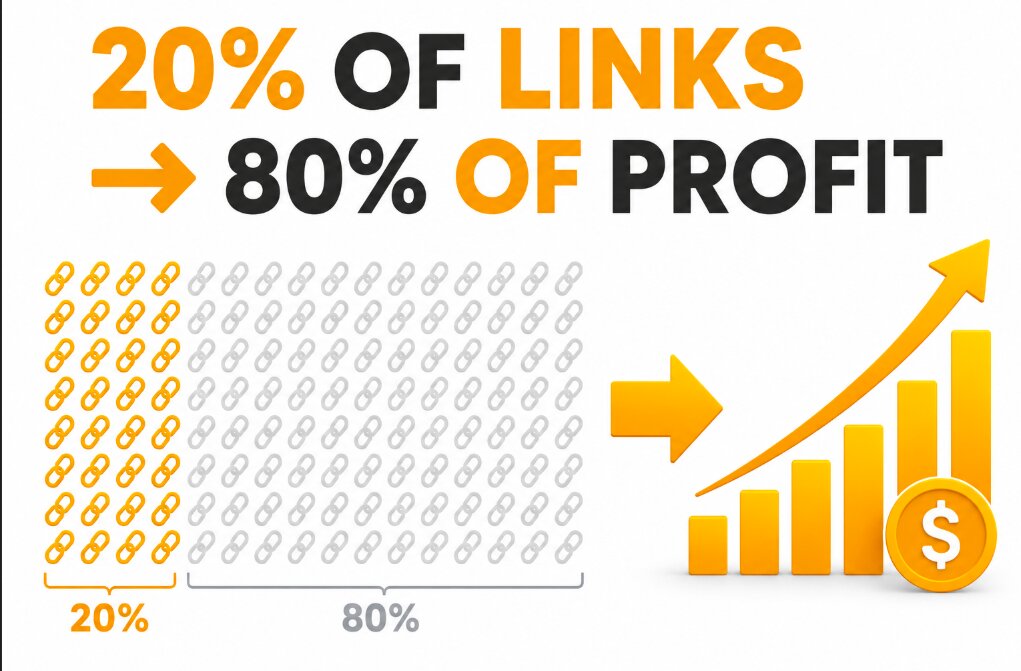
The Pareto Principle, also known as the 80/20 Rule, states that roughly 80% of outcomes come from 20% of causes. In link building, this often means that a small portion of your backlinks generates the majority of your conversions, leads, and profit.
The challenge is finding those high-impact links.
In this article, you'll learn how to identify the backlinks that truly matter, measure their business impact, and make better link-building decisions based on revenue rather than vanity metrics.
Why Most Link Tracking Fails
Many marketers focus on metrics that are easy to measure:
- Number of backlinks
- Domain Rating (DR)
- Domain Authority (DA)
- Organic traffic
- Referral traffic
These metrics are useful, but they don't answer the most important question:
Which links are making us money?
A backlink from a DR90 website may look impressive. However, a niche blog with lower authority might send visitors who actually become customers.
Without proper tracking, both links appear equally valuable.
The Problem with Attribution
A customer rarely discovers your business and converts immediately.
A typical journey might look like this:
- Reads an article on a partner website
- Clicks your backlink
- Leaves without converting
- Returns through Google a week later
- Signs up or purchases
If you're only looking at last-click attribution, the backlink receives zero credit even though it initiated the customer journey.
This creates a distorted view of link performance.
The 80/20 Reality of Backlinks
After analyzing backlink portfolios across different industries, a common pattern appears:
- Most backlinks generate no measurable business value.
- Some help rankings but send little traffic.
- A small group consistently influences leads, sales, and revenue.
This is where the 80/20 Rule becomes visible.
What High-Value Links Usually Have in Common
The backlinks that drive results often share several characteristics:
Audience Relevance
A link from a website serving your ideal customers typically outperforms a more authoritative but unrelated site.
For example, a SaaS company may gain more qualified leads from a niche software blog than from a large general business publication.
Strong Contextual Placement
Links embedded naturally within relevant content tend to generate more clicks than links placed in author bios, footers, or resource pages.
High Buyer Intent
Content targeting users close to making a decision often delivers better conversion rates than purely informational content.
Someone reading "best project management tools for agencies" is usually closer to purchasing than someone reading "what is project management."
How to Identify the 20% of Links Driving Profit
The process is simpler than most marketers expect.
Step 1: Track Every Important Link
Start by creating a list of your key backlinks.
For each link, collect:
- Referring domain
- Landing page
- Referral traffic
- Conversions
- Revenue generated
If possible, use UTM parameters on partnership links and sponsored placements.
This creates a direct connection between the backlink and business outcomes.
Step 2: Measure Conversion Quality
Traffic alone is misleading.
Link | Visits | Leads | Revenue
Website A | 2,000 | 5 | $500
Website B | 300 | 25 | $5,000
Most marketers would celebrate Website A because it drives more traffic.
The smarter choice is Website B because it generates ten times more revenue.
Always evaluate links based on business impact, not visit volume.
Step 3: Rank Links by Revenue Contribution
Sort your backlinks according to:
- Revenue generated
- Assisted conversions
- Lead quality
- Customer lifetime value
You'll often discover that a surprisingly small group of links accounts for the majority of your results.
That's your profitable 20%.
Step 4: Look for Patterns
Once you've identified your top-performing links, analyze what they have in common.
Ask:
- Which industries are linking to us?
- What content formats generate conversions?
- Which websites send qualified visitors?
- What anchor texts attract clicks?
These patterns become your future link-building strategy.
How Linkorio Helps You Find Your Best Links Faster
The biggest challenge isn't collecting backlink data.
It's connecting backlinks with business outcomes.
Most SEO tools show:
- Link metrics
- Authority scores
- Traffic estimates
But they rarely answer:
Which backlink generated actual revenue?
Linkorio helps bridge that gap by making link tracking more actionable and performance-focused.
Instead of treating all backlinks equally, marketers can identify:
- Links that generate conversions
- Links that influence customer journeys
- Links worth replicating
- Links that are no longer delivering value
This allows teams to focus their resources where the return is highest.
What to Do After Finding Your Top 20%
Discovery is only the first step.
The real value comes from acting on the insights.
Double Down on Winning Sources
If a particular website consistently sends qualified leads, explore additional opportunities:
- Guest posts
- Partnership content
- Case studies
- Resource placements
Replicate Successful Link Types
If comparison articles convert well, seek more placements in comparison content.
If industry directories drive qualified traffic, expand your presence there.
Focus on proven patterns instead of experimenting blindly.
Remove Reporting Noise
Not every backlink deserves attention.
Once you know which links drive business results, reporting becomes clearer and decision-making becomes easier.
You spend less time chasing vanity metrics and more time improving ROI.
Conclusion
The goal of link building isn't collecting the largest number of backlinks.
It's generating business growth.
The 80/20 Rule shows that a small percentage of your backlinks likely creates the majority of your revenue. Identifying those links allows you to invest more intelligently, scale what's already working, and stop wasting resources on low-impact activities.
When you track links based on profit rather than popularity, link building stops being an SEO activity and becomes a growth strategy.
If you're serious about understanding the real value of your backlinks, start by finding the 20% that drive 80% of your results.