
Most companies don’t have a traffic problem.
They have an allocation problem.
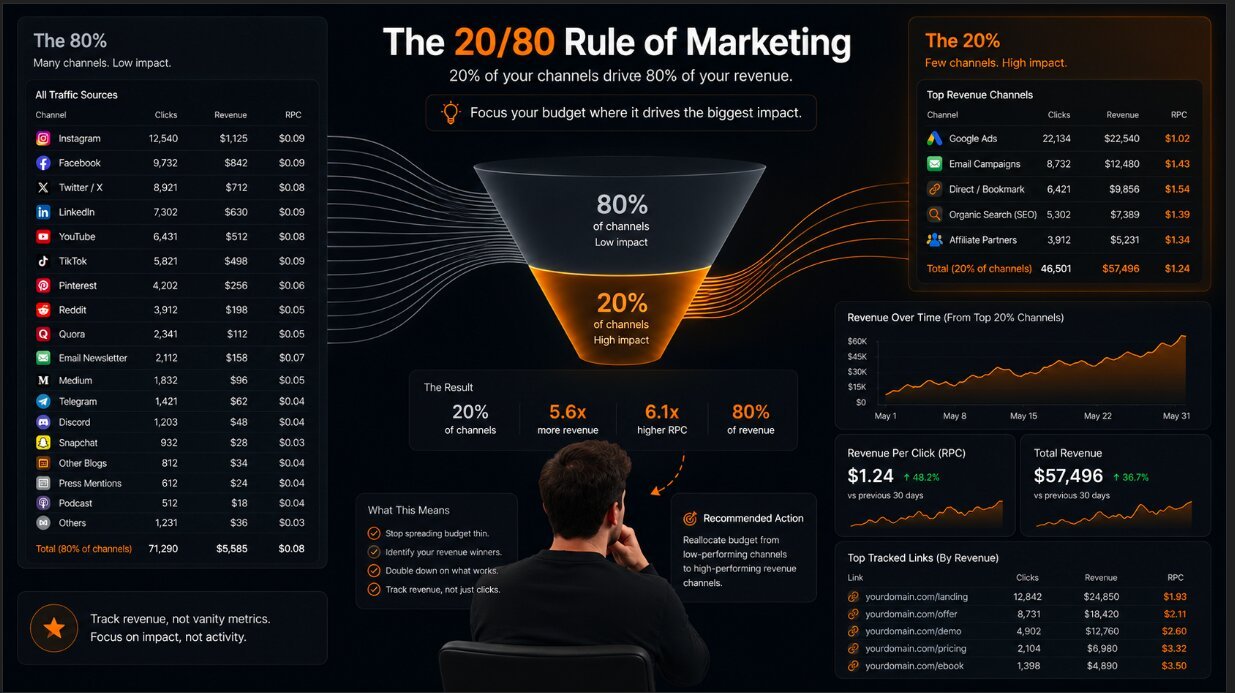
The 20/80 rule of marketing explains why: a small percentage of your channels, campaigns, and links often create the majority of your revenue.
But many teams still spread budget and attention evenly.
They chase more traffic.
They launch more campaigns.
They try to grow every channel at the same time.
The smarter move is different.
Find the small group of marketing sources already creating results — then invest more into those.
Why Most Marketing Teams Spread Their Budget Too Thin
Most marketing teams evaluate channels using numbers that are easy to see.
They look at:
- Traffic
- Followers
- Clicks
- Impressions
- Engagement
These metrics are not useless.
They provide signals.
The problem is when they become the decision-maker.
A channel can generate thousands of visitors and still produce weak revenue.
Another channel can bring in fewer visitors and quietly become the biggest source of customers.
The difference is profitability.
A high-traffic channel is not automatically a high-value channel.
The Problem With Activity Without Attribution
A common mistake is rewarding activity instead of outcomes.
A marketing dashboard might show:
"This channel generated 100,000 visits."
But the more important question is:
"How much revenue did those visits create?"
Without proper revenue attribution, teams end up investing in channels that look busy instead of channels that perform.
This creates wasted budget.
More importantly, it hides the opportunities already working.
The enemy is not a lack of marketing activity.
It is activity without understanding.
The 20/80 Rule of Marketing Channels
The 20/80 rule of marketing is based on the idea that a small percentage of inputs often create a large percentage of results.
In marketing, this means:
- A few channels may create most customers
- A few campaigns may create most revenue
- A few links may outperform everything else
The goal is not finding more channels.
The goal is finding your winning 20%.
The challenge is identifying it.
That requires better measurement.
Why Revenue Per Click Reveals the Winners
One of the strongest ways to identify valuable traffic is Revenue Per Click (RPC).
The formula is simple:
Revenue ÷ Clicks = Revenue Per Click
RPC shows the value behind each visitor.
It answers:
"How much revenue does this traffic actually create?"
This is more useful than asking:
"How much traffic did this channel send?"
Because volume can be misleading.
A channel with fewer clicks can be the better investment if those clicks create higher-value customers.
What Your Winning 20% Might Look Like
The best-performing channels are not always obvious.
Consider two traffic sources.
Channel A
- 50,000 visitors
- $2,000 revenue
Channel B
- 5,000 visitors
- $10,000 revenue
Channel A looks impressive.
More visitors.
More activity.
More reach.
But Channel B is the real winner.
The traffic is more valuable.
The audience is more likely to buy.
The marketing decision should be obvious:
Invest more into Channel B.
This is where many companies lose money.
They optimize for attention instead of results.
Real Examples of Hidden Winners
Your highest-performing channel might be something unexpected.
Examples:
A newsletter outperforming social media
A company may spend months growing social reach while a small email audience consistently drives purchases.
A small creator outperforming a large influencer
A niche creator with the right audience can generate more revenue than someone with millions of followers.
One landing page outperforming an entire campaign
A single page might convert better because it attracts higher-intent visitors.
One partnership driving high-value customers
A partner may send fewer visitors but customers with stronger lifetime value.
The winning 20% is often hidden inside your existing marketing.
You just need the right data.
How to Find Your Highest-Performing Marketing Channels
Finding your best channels requires moving beyond basic channel reporting.
Track Every Channel at the Link Level
Channel-level data is a starting point.
But it often hides the details that matter.
A platform report might tell you:
"Paid ads generated sales."
That is useful.
But which ad?
Which creative?
Which landing page?
Which link?
To find your real winners, track individual marketing assets.
This includes:
- Paid campaigns
- Social posts
- Email links
- Partnerships
- Affiliate links
- Content pages
Link-level tracking shows which specific sources create revenue.
Without it, profitable opportunities stay invisible.
Rank Channels by Revenue, Not Reach
The best channels are not always the biggest.
Evaluate marketing sources based on:
- Revenue generated
- Revenue Per Click
- Customer quality
- Conversion value
Avoid making decisions only from:
- Click volume
- Traffic size
- Engagement
A channel with 10,000 clicks and low revenue should not automatically beat a channel with 1,000 clicks and strong customer value.
The goal is profitable traffic.
Not more traffic.
Cut the Bottom 80%
Growth often comes from removing distractions.
Many companies keep investing in channels because they already invested time there.
That is a mistake.
Past effort does not guarantee future returns.
Look for:
- Campaigns producing weak revenue
- Traffic sources that never convert
- Channels consuming resources without results
The goal is not maintaining every channel.
The goal is improving your marketing allocation.
Double Down on the Winners
Once you identify your strongest channels, increase investment.
The process is simple:
- Identify top revenue sources
- Increase investment
- Create more campaigns around winners
- Continue measuring performance
The best growth strategy is often not finding something new.
It is scaling what already works.
Why Channel-Level Analytics Are Not Enough
Tools like Google Analytics, UTM reporting, and marketing dashboards help organize information.
They answer questions like:
- Where did traffic come from?
- Which campaigns received visitors?
- Which channels are active?
But they often stop before the most important question:
"What created revenue?"
That requires connecting marketing activity to actual outcomes.
A channel is only valuable because of what it produces.
Marketing Metrics Comparison
| Metric | What It Measures | Problem | Better Approach |
| Traffic | Visitors | Doesn’t show value | Revenue attribution |
| Clicks | Interest | Doesn’t show buyers | RPC |
| Engagement | Attention | Doesn’t show sales | Revenue data |
| Channel revenue | Sales source | Missing link detail | Link-level attribution |
| RPC | Revenue quality | Shows profitable traffic | Better allocation |
The difference is simple.
Traditional reporting tells you what happened.
Revenue-focused reporting helps you decide what to do next.
Find Your Winning 20% With Revenue Data
Linkorio helps marketers identify which links, channels, and campaigns actually generate revenue.
Instead of optimizing based only on traffic numbers, teams can understand which marketing efforts create customers.
That makes it easier to:
- Find profitable channels
- Improve marketing optimization
- Allocate budget with confidence
- Scale what already works
The goal is not more dashboards.
The goal is better decisions.
Conclusion
The goal is not to grow every marketing channel.
The goal is to find the channels that deserve more investment.
The smartest marketers do not chase more traffic blindly.
They identify what already works and scale it.
The 20/80 rule of marketing is not about doing less.
It is about focusing more on the activities that create the most value.
The future of marketing belongs to teams that understand not just where attention comes from — but where revenue comes from.
Frequently Asked Questions
What is the 20/80 rule of marketing?
The 20/80 rule of marketing means that a small percentage of channels, campaigns, or links often generate a large share of marketing results.
How do I find my most profitable marketing channels?
Use revenue attribution and link-level tracking to compare channels based on revenue, customer value, and Revenue Per Click instead of traffic alone.
Why is traffic volume a bad marketing metric?
Traffic shows how many people visited, but it does not show whether those visitors became customers or generated revenue.
What is Revenue Per Click?
Revenue Per Click measures how much revenue each click generates. It helps identify which traffic sources provide the most business value.
Should businesses stop using Google Analytics or UTM tracking?
No. These tools are useful for understanding traffic sources. The problem is relying on them alone without connecting activity to revenue.
Why do some smaller channels outperform larger ones?
Smaller channels often have more relevant audiences and higher purchase intent, resulting in better traffic quality and stronger revenue.