
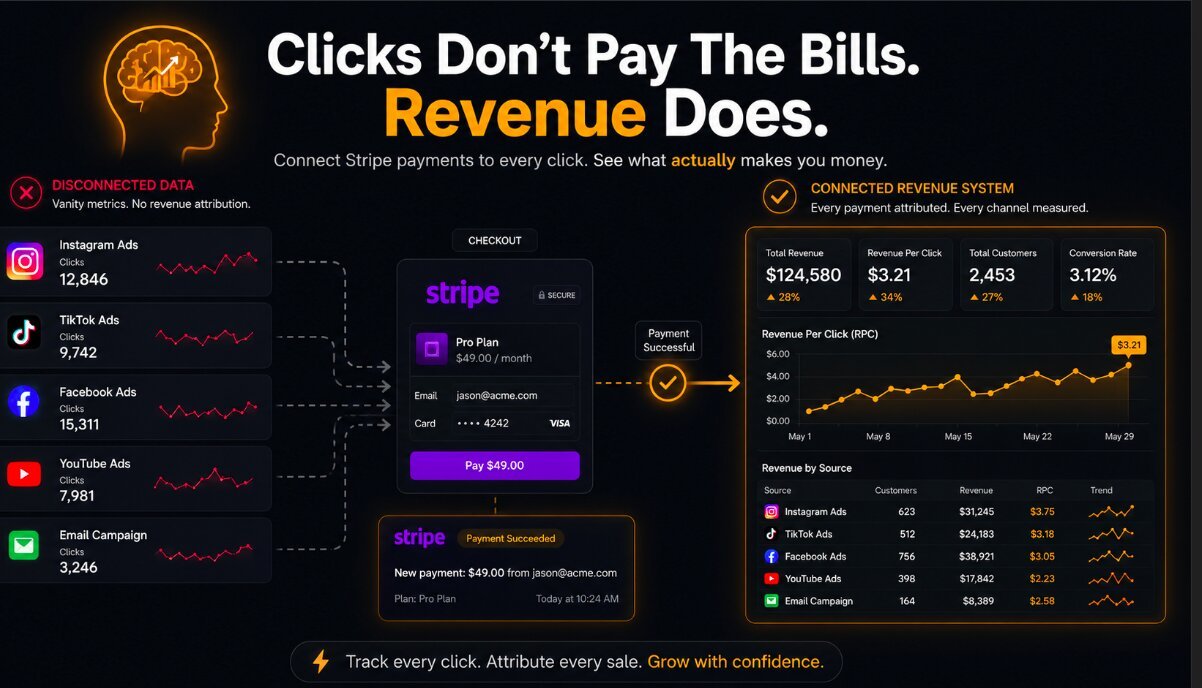
Stripe tells you who paid.
It tells you the customer, the payment amount, the subscription, and the transaction history.
But it does not tell you why they paid.
That is the gap most SaaS founders and marketers miss. A successful payment does not automatically reveal which campaign, content piece, partner link, or marketing effort created the customer.
This is why Stripe link analytics matters.
Revenue is the outcome. Attribution explains the decisions that created it.
Without that connection, businesses end up optimizing clicks, traffic, and campaigns without knowing what actually drives sales.
Stripe Shows Revenue. Your Marketing Still Has Blind Spots.
Stripe is excellent at handling payments.
You can see:
- Payments
- Customers
- Revenue
- Subscriptions
- Refunds
- Billing activity
Your marketing tools show a different side of the business.
You can see:
- Clicks
- Traffic
- Campaigns
- Engagement
- Conversion events
The problem is that these systems often live separately.
Your Stripe dashboard knows a customer paid $500.
Your analytics platform knows someone clicked a campaign link.
But can you confidently answer:
- Which link generated this customer?
- Which campaign created the highest-value buyers?
- Which content actually produced revenue?
- Which traffic source deserves more budget?
Most companies cannot.
They have payment data.
They have marketing data.
They do not have attribution connecting the two.
That creates expensive blind spots.
The Problem With Disconnected Data
Many businesses still make decisions based on incomplete information.
A campaign gets more clicks, so the budget increases.
A landing page gets more traffic, so the team assumes it is working.
A channel reports strong engagement, so everyone assumes it is valuable.
But none of those metrics answer the most important question:
Did this activity create revenue?
This is where traditional dashboards fall short.
They show activity.
They do not always show impact.
The Missing Piece in Stripe Revenue Attribution
Payment data alone is not enough.
Knowing that a customer paid $500 is useful.
Knowing that the customer came from:
- A specific LinkedIn post
- A partner referral link
- A newsletter campaign
- A product comparison page
- A paid advertising campaign
is what helps you grow.
That is the difference between payment tracking and Stripe revenue attribution.
Payment tracking tells you what happened.
Revenue attribution tells you what caused it.
Why Link-Level Attribution Matters
Most businesses measure performance at the campaign level.
For example:
"LinkedIn generated $10,000 this month."
Useful.
But incomplete.
Inside that LinkedIn result could be:
- 20 posts
- 5 creators
- Multiple landing pages
- Different offers
- Several tracking links
Some of those assets may generate customers.
Others may generate nothing.
Without link-level attribution, they all get grouped together.
That makes optimization harder.
Revenue Per Click Reveals Traffic Quality
One of the most useful metrics for understanding marketing performance is Revenue Per Click (RPC).
RPC measures how much revenue each click generates.
Formula:
Revenue Per Click = Revenue ÷ Clicks
Consider two campaigns.
Campaign A
- 5,000 clicks
- $2,000 revenue
Campaign B
- 500 clicks
- $5,000 revenue
Most dashboards make Campaign A look better.
It generated more traffic.
More activity.
More clicks.
But Campaign B is the real winner.
It generates more revenue with fewer visitors.
The difference is traffic quality.
RPC helps identify which clicks actually matter.
How to Connect Stripe Payments Back to Your Marketing
Better attribution starts with tracking the entire customer journey.
The goal:
Connect marketing actions to payment outcomes.
Track Every Important Marketing Link
Every important marketing source should have its own trackable link.
This includes:
- Landing pages
- Paid ads
- Newsletter campaigns
- Partner campaigns
- Social posts
- Product pages
- Affiliate links
A common mistake is using one generic destination URL everywhere.
That makes it impossible to understand what created revenue.
A SaaS company might promote the same product through:
- A LinkedIn post
- A founder newsletter
- A partner article
- A paid search campaign
If all traffic goes through the same link, attribution becomes guesswork.
Separate tracking creates clarity.
You can finally see which sources bring customers.
Connect Clicks to Stripe Customers
Clicks are only the beginning.
A complete attribution system follows the entire path:
Marketing link → Website visit → Signup/demo/trial → Stripe payment → Revenue attribution
This matters because not every click has the same value.
A visitor who clicks a product comparison article and starts a paid subscription is different from someone who clicks a viral post and leaves immediately.
Both are clicks.
Only one creates revenue.
The goal is understanding the difference.
Measure Revenue Per Click, Not Just Conversion Rate
Conversion rate is useful.
But it can create misleading conclusions.
A source with a higher conversion rate is not always more valuable.
Example:
Traffic Source A:
- 100 visitors
- 10 purchases
- $1,000 revenue
Traffic Source B:
- 500 visitors
- 20 purchases
- $10,000 revenue
Source A converts at a higher rate.
Source B creates more revenue.
If you only optimize for conversion rate, you might overlook the better growth opportunity.
RPC adds revenue quality to the equation.
It helps you understand:
- Which traffic creates valuable customers
- Which campaigns deserve investment
- Which links attract serious buyers
Find Your Highest-Value Acquisition Channels
Good attribution reveals patterns that traditional reporting hides.
You may discover:
- A small partner sends your best customers
- A niche newsletter beats a larger audience
- One product page converts dramatically better
- A specific campaign creates higher-value subscriptions
These insights change how you spend.
Instead of asking:
"Where are we getting traffic?"
You ask:
"Where are we getting customers worth acquiring?"
That is a much better growth question.
Stop Optimizing Based on Traffic Alone
Many founders fall into the same trap.
They chase:
- More visitors
- More clicks
- More impressions
- More engagement
Those numbers can look impressive.
They can also hide weak marketing performance.
A campaign generating 50,000 clicks but zero paying customers is not successful.
A campaign generating 500 clicks and $20,000 in revenue deserves attention.
The goal is not more activity.
The goal is more profitable activity.
Marketing Attribution vs Payment Analytics
| Metric | What It Shows | What It Misses | Better Approach |
| Stripe Dashboard | Payments | Marketing source | Revenue attribution |
| Google Analytics | Traffic | Payment value | Link-to-revenue tracking |
| CTR | Click interest | Customer quality | Revenue Per Click |
| Conversion Rate | Buyers | Revenue size | Revenue attribution |
The biggest mistake companies make is assuming measurement equals understanding.
Seeing data is not the same as knowing what to do with it.
Common Mistakes With Stripe Attribution
Many SaaS and ecommerce teams struggle because their data is fragmented.
Common mistakes include:
- Tracking payments without tracking acquisition sources
- Measuring clicks without measuring revenue
- Relying only on UTM parameters
- Optimizing campaigns by traffic volume
- Ignoring customer value after conversion
- Treating every channel as equally valuable
UTM tracking helps organize campaigns.
It does not always answer the deeper question:
Which specific link created the customer?
That is where stronger marketing attribution for Stripe becomes valuable.
Connect Your Marketing Links to Real Revenue
Linkorio helps founders and marketers connect marketing links directly to Stripe revenue.
Instead of only seeing clicks, traffic, or campaign activity, you can understand which links, sources, and campaigns actually create paying customers.
This makes it easier to identify:
- Revenue-generating channels
- High-value campaigns
- Profitable partnerships
- Better acquisition opportunities
The goal is not collecting more dashboards.
The goal is knowing what drives revenue.
Conclusion
Revenue is the final result.
Attribution explains the decisions that create it.
The companies that grow fastest are not the ones collecting the most clicks.
They are the ones understanding which clicks become customers.
By connecting Stripe payments with link-level tracking, businesses can stop guessing and start investing based on real revenue data.
The future of growth is not more traffic reporting.
It is building a revenue-first marketing system where every important click has a measurable business outcome.
Frequently Asked Questions
What is Stripe link analytics?
Stripe link analytics connects marketing links with Stripe payment data so businesses can understand which campaigns, sources, and content generate revenue.
Why is Stripe revenue attribution important?
Stripe shows who paid and how much they paid, but attribution explains which marketing activity created that customer. This helps businesses make better budget decisions.
Is tracking clicks enough for SaaS growth?
No. Clicks measure interest, but they do not show customer value. Revenue Per Click helps identify which traffic sources actually produce revenue.
Are UTM parameters enough for Stripe attribution?
UTMs help organize traffic sources, but they often do not provide complete link-level revenue attribution. They show where traffic came from, not always what created the sale.
How does Revenue Per Click help marketers?
Revenue Per Click shows the amount of revenue generated from each click. It helps teams compare traffic sources based on profitability instead of volume.
Can Stripe link analytics help subscription businesses?
Yes. Subscription businesses can use attribution to understand which links and campaigns generate valuable customers, trials, and recurring revenue.