
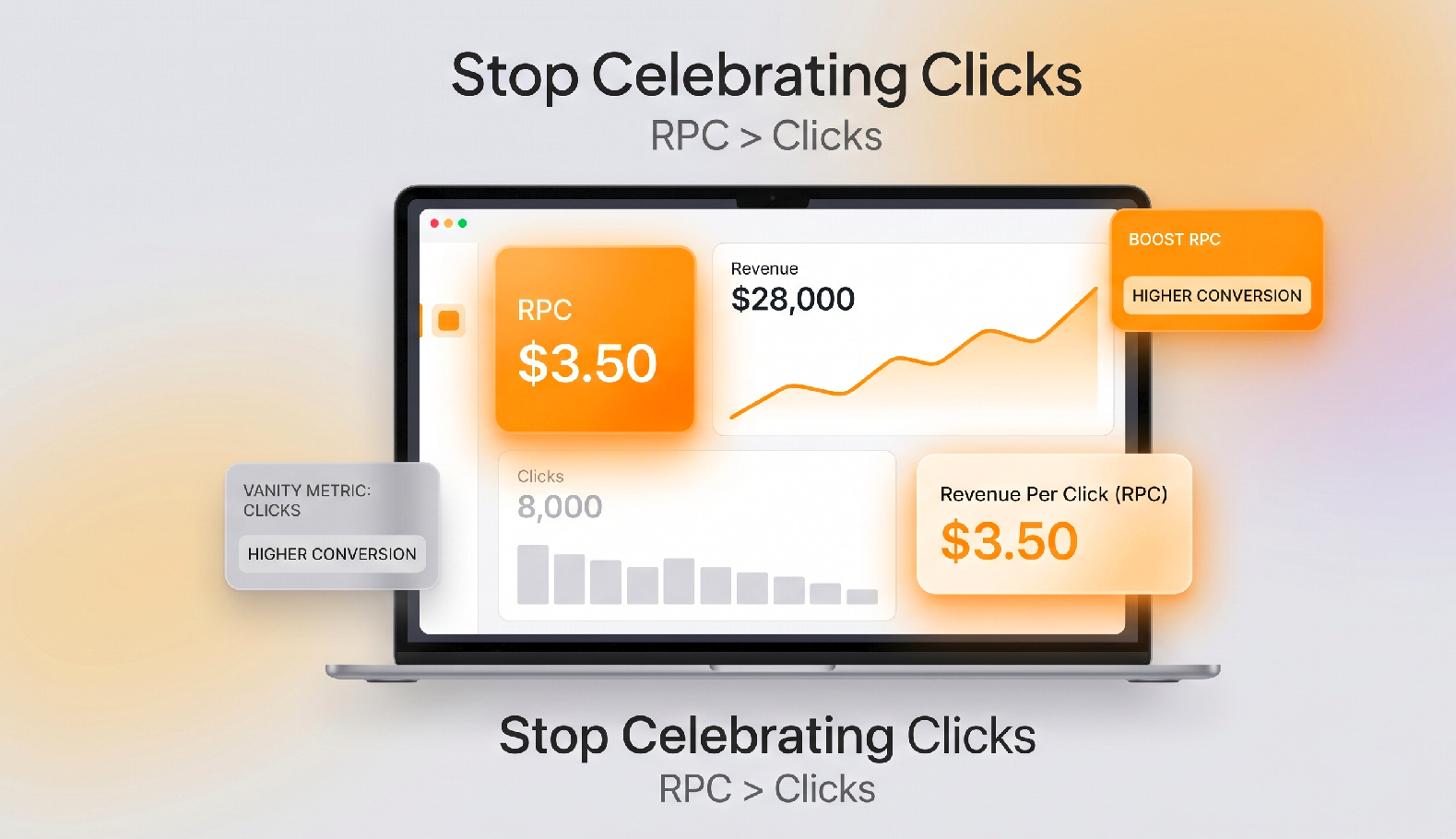
A 5% click-through rate feels like success.
A spike in traffic feels like growth.
But neither pays your bills.
In 2026, clicks are easier to fake, inflate, and misinterpret than ever. Bots, curiosity clicks, and low-intent traffic make traditional metrics unreliable.
If you’re still optimizing for clicks, you’re optimizing for noise.
This article shows why Revenue Per Click (RPC) is the only metric that matters—and how to use it to actually grow.
The Illusion of Click-Based Metrics
Clicks Are Cheap
Getting clicks today is easy:
- Clickbait headlines
- Viral posts
- Bot traffic
- Accidental taps (especially on mobile)
But clicks don’t equal intent.
A user can click and leave in 2 seconds.
High CTR Can Be Misleading
You can have:
- High CTR
- High traffic
- Zero revenue
Example:
A tweet goes viral:
- 10,000 clicks
- $0 in affiliate revenue
Looks like success. It’s not.
Platforms Incentivize the Wrong Behavior
Most platforms reward:
- Engagement
- Clicks
- Watch time
Not revenue.
So creators optimize for what platforms want—not what actually makes money.
What RPC Actually Measures
The Metric That Connects Everything
RPC (Revenue Per Click) answers one question:
“How much money does each click generate?”
Instead of guessing, you get a direct signal.
Formula
RPC=Total RevenueTotal ClicksRPC = \frac{\text{Total Revenue}}{\text{Total Clicks}}RPC=Total ClicksTotal Revenue
That’s it.
No vanity. No fluff.
Why RPC Is Different
RPC combines:
- Traffic quality
- Conversion rate
- Offer strength
Into a single number.
It tells you:
- Which content makes money
- Which platform is worth your time
- Which links to scale
Why RPC Wins in 2026
1. It Filters Out Low-Intent Traffic
Bots and random clicks don’t convert.
So they naturally lower RPC.
That means:
- Fake traffic → exposed instantly
- Real buyers → stand out
Most people choose Link A (more clicks).
Smart operators choose Link B.
RPC forces better decisions.
It Aligns With Actual Business Goals
You don’t need:
- More clicks
- More impressions
You need:
- More revenue
RPC aligns your content strategy with that goal.
How to Start Tracking RPC Properly
Step 1: Stop Reusing Links Everywhere
Use unique links per:
- Platform
- Campaign
- Content piece
Otherwise, you can’t isolate performance.
Track Through a Central Layer
Don’t send traffic directly to affiliate links.
Use a tracking layer (like Linkorio):
Flow:
- User clicks
- Data gets recorded (source, campaign)
- User goes to destination
This is where RPC becomes measurable.
Connect Revenue Back to Clicks
You need to match:
- Click → Conversion → Revenue
Ways to do it:
- Postbacks (best)
- API integrations
- Manual matching (temporary)
Without this step, RPC doesn’t exist.
Analyze and Act
Once you have RPC:
Do more of:
- High RPC content
- High RPC platforms
Kill:
- High click, low RPC content
This is where growth happens.
Real-World Shift: From Traffic to Profit
Most creators think like this:
“How do I get more clicks?”
Better question:
“Which clicks are worth the most?”
That shift changes everything.
Instead of chasing virality, you:
- Optimize funnels
- Improve offers
- Target better audiences
And your revenue scales—even with less traffic.
Clicks are easy to manipulate.
Revenue isn’t.
If you want to grow in 2026, stop measuring:
- CTR
- Traffic spikes
- Vanity metrics
Start measuring:
- Revenue Per Click (RPC)
Because at the end of the day:
A click that doesn’t make money is just noise.