
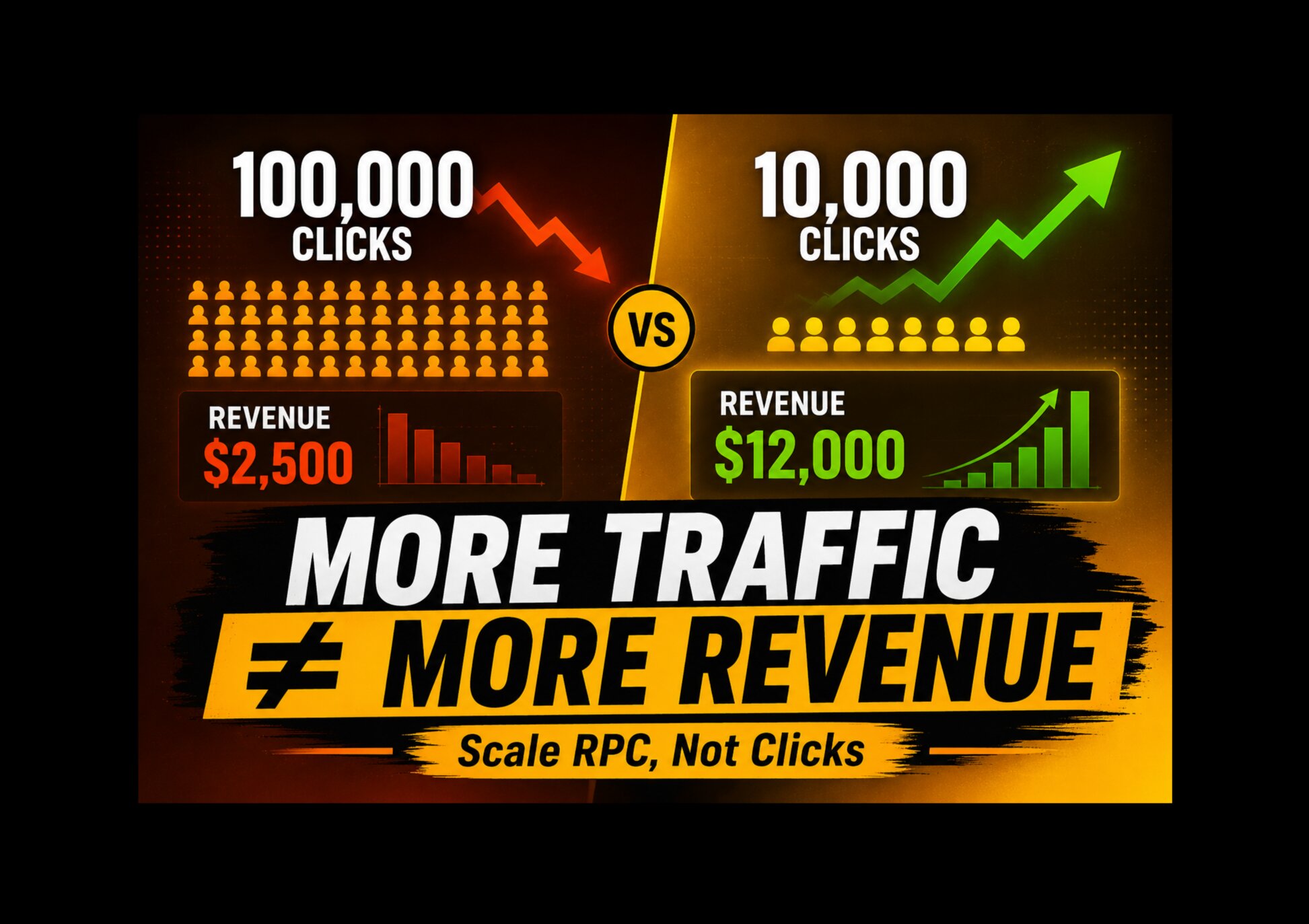
Most marketers scale the wrong traffic.
They look at click volume, CTR, impressions, or channel reputation and assume more traffic means more revenue. But the channels sending the most visitors are often not the channels generating the most sales.
The fastest path to growth isn't getting more traffic. It's identifying your highest-converting traffic sources and investing more heavily in the ones already producing revenue.
Why Most Traffic Scaling Efforts Fail
The typical growth playbook sounds logical:
- Find a channel that's driving traffic
- Increase budget
- Publish more content
- Buy more placements
- Expect revenue to follow
The problem? Traffic is not revenue.
Many scaling decisions are built on metrics that look impressive in reports but have little connection to business outcomes. CTR, sessions, pageviews, and even conversion rate can all be misleading when viewed in isolation.
If you don't know which clicks generate money, you're making growth decisions blind.
That's why companies often spend months scaling channels that appear successful while ignoring smaller sources quietly producing the highest returns.
The Problem With Chasing More Traffic
There's a dangerous assumption in marketing:
More traffic = more revenue.
Sometimes that's true. Often it isn't.
A traffic source can deliver thousands of visitors and still contribute very little to your bottom line. Meanwhile, a smaller source with fewer clicks may generate significantly more sales.
The real enemy is poor attribution.
Traditional analytics tools show where visitors came from. They rarely show which individual links, placements, partnerships, or campaigns actually generated revenue.
This creates attribution gaps that hide your best-performing opportunities.
As a result:
- Winning channels get underfunded
- Weak channels get scaled
- Marketing budgets become inefficient
- Growth slows despite increasing traffic
The channel with the most traffic is rarely the channel generating the most value.
Revenue Per Click: The Metric That Shows What Actually Works
If your goal is growth, you need a metric tied directly to revenue.
That's where Revenue Per Click (RPC) comes in.
Revenue Per Click measures how much revenue each click generates on average.
The formula is simple:
RPC = Total Revenue ÷ Total Clicks
Unlike CTR, CPC, or traffic volume, RPC connects acquisition activity directly to business results.
A source generating 1,000 clicks and $5,000 in revenue has a higher scaling priority than a source generating 10,000 clicks and the same revenue.
Why?
Because every additional click is worth more.
RPC tells you where additional investment is most likely to produce profitable growth.
Traffic Volume vs Revenue: A Better Way to Scale
Consider the following example:
Traffic | Source | Clicks | Conversion Rate | Revenue | RPC
Source A | 10,000 | 0.5% | $2,500 | $0.25
Source B | 2,000 | 4% | $4,000 | $2.00
Source C | 5,000 | 1% | $2,000 | $0.40
At first glance, Source A appears strongest because it drives the most traffic.
But Source B generates more revenue with one-fifth the traffic.
If you're deciding where to allocate the next $5,000 in budget, Source B is the obvious winner.
RPC reveals opportunities that traffic reports hide.
How to Find Your Highest-Converting Traffic Sources
Finding your highest-converting traffic sources isn't complicated.
The challenge is measuring them accurately and consistently.
The process follows a simple framework.
Step 1: Audit Every Traffic Source
Start by listing every meaningful source of traffic.
This includes:
- Organic search
- Paid search
- Social media
- Email campaigns
- Affiliate partnerships
- Referral traffic
- Influencer placements
- Guest posts
- Community mentions
Many businesses discover they have dozens of active traffic sources but only track performance at the channel level.
That's not enough.
You need visibility into individual links, campaigns, and placements.
Step 2: Measure Revenue Per Click
Next, connect revenue data to every traffic source.
Instead of asking:
"How many clicks did this get?"
Ask:
"How much revenue did these clicks generate?"
Calculate RPC for every source and rank them from highest to lowest.
This immediately exposes which traffic sources deserve more attention.
The goal isn't maximizing clicks. The goal is maximizing revenue generated per click.
Step 3: Identify the Top 20% of Sources
The 80/20 principle applies surprisingly well to traffic acquisition.
In many businesses:
- 20% of traffic sources generate 80% of revenue
- 20% of campaigns produce most conversions
- 20% of partnerships create most customer value
Once RPC is calculated, identify your top-performing segment.
These are your scaling candidates.
Don't assume the largest sources are the best.
Let the revenue data decide.
Step 4: Increase Investment Strategically
Scaling winners doesn't mean blindly doubling spend overnight.
Instead:
Expand Content
Create more content around topics and channels already producing high RPC.
Increase Promotion
Give your best-performing placements more visibility.
Strengthen Partnerships
Invest more heavily in affiliates, creators, and partners generating measurable revenue.
Test Adjacent Opportunities
Look for similar audiences, platforms, and placements that resemble existing winners.
The goal is controlled expansion, not reckless spending.
Step 5: Monitor for Diminishing Returns
Every traffic source eventually reaches a point where performance starts to decline.
Audience saturation happens.
Competition increases.
Costs rise.
This is why continuous measurement matters.
Monitor:
- RPC trends
- Conversion rates
- Customer acquisition costs
- Revenue growth
When RPC starts falling, reassess before increasing investment further.
Scaling should be data-driven, not momentum-driven.
Common Mistakes When Scaling Traffic
Even experienced marketers make predictable mistakes.
Scaling Before Attribution Is Accurate
If revenue tracking is incomplete, you're optimizing based on assumptions.
Fix attribution first.
Prioritizing Volume Over Value
Large traffic numbers create false confidence.
Revenue is the metric that matters.
Ignoring Smaller Channels
Some of the highest-performing traffic sources appear insignificant until RPC is measured.
Evaluating Channels Too Early
Short-term fluctuations happen.
Make decisions based on meaningful data, not a few days of performance.
Treating Every Click Equally
Not all clicks have the same value.
A click from a high-intent buyer can be worth dozens of clicks from a casual visitor.
Why Revenue Attribution Changes Growth Decisions
Traditional link analytics answer one question:
"Where did visitors come from?"
Revenue attribution answers a much more important question:
"Which clicks generated revenue?"
That's the difference.
Traffic reports show activity.
Revenue attribution shows value.
Once you understand which links, placements, campaigns, and channels consistently generate the highest RPC, growth decisions become dramatically easier.
You stop guessing.
You stop chasing vanity metrics.
You start investing where revenue already exists.
Scale What Already Works
Before you spend more money acquiring traffic, make sure you know which links actually generate revenue.
Linkorio helps marketers track Revenue Per Click, connect clicks to sales, and identify which traffic sources deserve more budget, content, and promotion. Instead of relying on clicks, sessions, or UTM reports alone, you can see exactly where revenue originates and scale with confidence.
Conclusion
The biggest growth opportunities are often hidden inside your existing traffic.
Most marketers look at volume and assume that's where they should invest. The smarter approach is to identify the high-converting traffic sources generating the highest Revenue Per Click and systematically double down on them.
Because sustainable growth doesn't come from getting more clicks.
It comes from getting more revenue from the clicks you're already earning.