
I spent years trying to grow an audience.
More followers. More engagement. More reach.
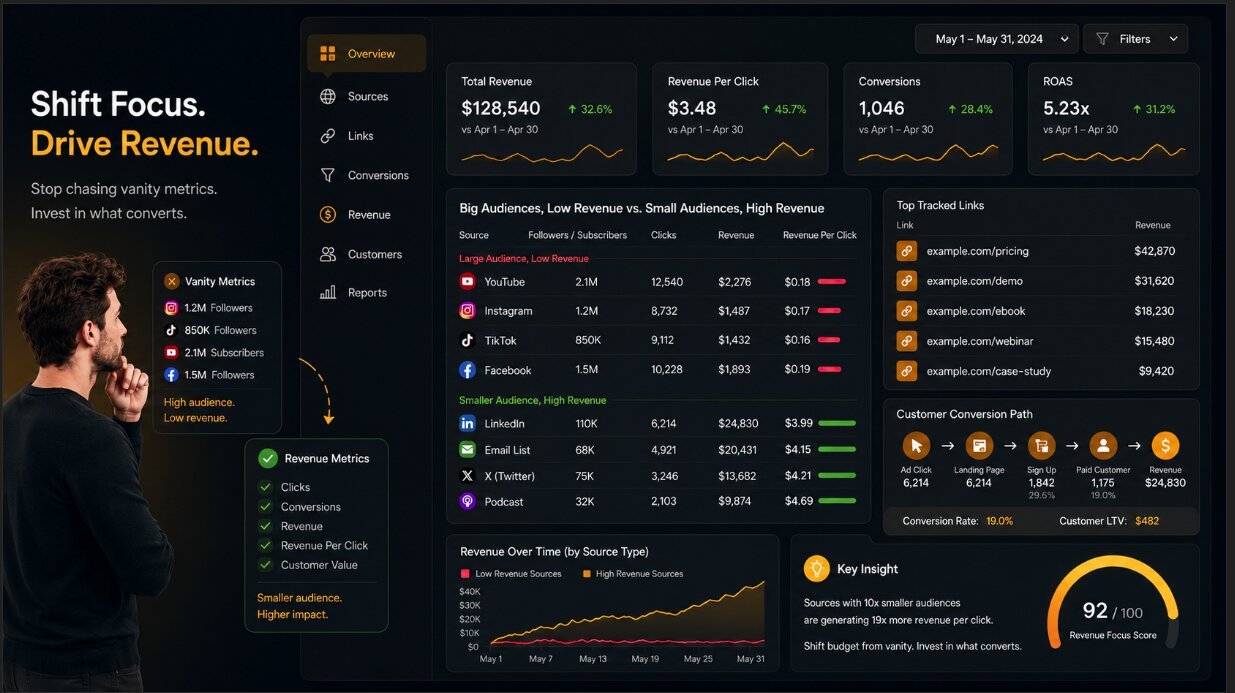
Then I realized something uncomfortable: the biggest audience was not always the audience creating the most revenue.
A post could reach thousands of people and generate almost nothing.
Another could reach a fraction of that audience and bring in paying customers.
That changed how I looked at marketing.
I stopped measuring success by attention alone and started focusing on Revenue Per Click.
Because attention is easy to collect.
Revenue is harder to earn.
Followers Are Easy to Count. Revenue Is Harder to Understand.
Most brands know exactly how many followers they have.
They know:
- Followers
- Likes
- Views
- Shares
- Engagement rate
These numbers feel like progress because they move constantly.
A post goes viral.
A follower count increases.
A video gets thousands of views.
It feels like marketing is working.
But these metrics only measure attention.
They do not answer the question that matters:
Did this attention create customers?
That is where many businesses get stuck.
A creator with 100,000 followers can generate fewer sales than someone with 2,000 followers who has a highly relevant audience.
A social post with 50,000 views can create less revenue than a targeted post with 500 views.
The difference is not reach.
The difference is intent.
The Problem With Vanity Metrics
Followers, impressions, and engagement are not useless.
They provide context.
The mistake is treating them as proof of business growth.
A large audience does not automatically mean:
- More buyers
- Better customers
- Higher revenue
- Stronger ROI
This is the trap of marketing vanity metrics.
They show activity.
They do not always show impact.
The real question is:
Which audience creates revenue?
Answering that requires better revenue attribution.
Why I Started Tracking Revenue Per Click Instead
The biggest shift happened when I started measuring Revenue Per Click (RPC).
The idea is simple:
Revenue Per Click = Revenue generated ÷ Number of clicks
Instead of asking:
"How many people saw this?"
I started asking:
"How much revenue did this attention create?"
That changed how I evaluated every campaign, creator, and content piece.
Consider two creators.
Creator A
- 50,000 followers
- 5,000 clicks
- $500 revenue
Creator B
- 5,000 followers
- 500 clicks
- $3,000 revenue
Creator A looks better on paper.
Bigger audience.
More clicks.
More visibility.
But Creator B is clearly more valuable.
The audience is smaller.
The revenue impact is larger.
The traffic quality is better.
This is what RPC reveals.
It separates attention from business value.
What Changed When I Stopped Optimizing for Followers
The hardest part was admitting that some of the things I celebrated were not actually moving the business forward.
Before tracking revenue properly, the focus was on visibility.
The goal was:
- Grow the audience
- Increase engagement
- Reach more people
- Create content that gets attention
The problem was that attention became the goal.
Not revenue.
Before: Optimizing for Visibility
The marketing decisions looked like this:
- Double down on posts with the most likes
- Prioritize channels with the biggest reach
- Celebrate follower growth
- Judge campaigns by engagement
The problem?
A highly engaged audience does not always become a paying audience.
After: Optimizing for Revenue
Once I started connecting links to revenue, the decision process changed.
I started tracking:
- Which links created customers
- Which audiences converted
- Which campaigns generated sales
- Which content attracted buyers
The results were different than expected.
Some large channels were weaker than smaller ones.
Some viral content created attention but no revenue.
Some smaller communities consistently produced better customers.
The winners were not always the biggest.
They were the most profitable.
How to Measure Whether Attention Actually Creates Revenue
A revenue-focused marketing system starts by measuring outcomes, not popularity.
Stop Measuring Audience Size Alone
Followers are not customers.
Reach is not revenue.
Engagement is not purchase intent.
A large audience can be valuable.
But only if that audience takes action.
The goal is not building the biggest audience possible.
The goal is building an audience that creates customers.
Track Every Important Link
To understand what creates revenue, every important traffic source needs attribution.
This includes:
- Social posts
- Newsletter links
- Creator campaigns
- Partnerships
- Content pages
- Affiliate campaigns
Without link tracking analytics, everything gets grouped together.
A social platform might show:
"Instagram drove traffic."
But that does not answer:
- Which post?
- Which creator?
- Which product link?
- Which campaign?
Link-level tracking creates visibility.
It connects attention to outcomes.
Compare Traffic Quality Using RPC
Not all clicks are equal.
Two sources can generate the same number of visitors and completely different results.
One audience might click out of curiosity.
Another might click because they are ready to buy.
RPC helps identify the difference.
It reveals:
- Valuable audiences
- Profitable channels
- Winning campaigns
- High-intent traffic
Instead of asking:
"Who gets the most attention?"
You ask:
"Who creates the most revenue?"
That is a much better marketing question.
Reallocate Effort Toward What Converts
Once you know which sources create revenue, the next step is simple.
- Find high-RPC sources
- Reduce time spent on low-value traffic
- Create more content around proven winners
This does not mean ignoring creativity.
It means creating with better information.
The goal is not making less content.
The goal is making content that has a higher chance of creating business results.
The Metrics I Stopped Using as My Main Growth Signals
I still look at engagement data.
But I no longer let it decide where resources go.
| Metric | What It Measures | Why It Can Mislead | Better Alternative |
| Followers | Audience size | Doesn't show buyers | Revenue attribution |
| Likes | Engagement | Doesn't show intent | Sales data |
| Views | Reach | Doesn't show value | Revenue Per Click |
| Clicks | Interest | Missing customer value | RPC |
| RPC | Revenue generated per click | Direct business impact | Better decisions |
The difference is simple.
Vanity metrics tell you what people noticed.
Revenue metrics tell you what people valued.
Common Mistakes Caused by Vanity Metrics
Many brands make the same mistakes:
- Choosing creators only by follower count
- Promoting content only because it performs well publicly
- Measuring campaigns by impressions
- Assuming engagement equals demand
- Ignoring which links create revenue
A post can be popular and unprofitable.
A creator can be small and extremely valuable.
A campaign can look impressive and still fail commercially.
The numbers need context.
Stop Measuring Attention. Start Measuring Revenue.
Linkorio helps marketers understand which links and audiences actually generate revenue.
Instead of relying only on followers, clicks, and engagement dashboards, teams can track which sources create customers and where attention turns into business results.
The goal is not another report full of surface-level metrics.
The goal is knowing which marketing efforts deserve more investment.
Conclusion
The goal is not to build the biggest audience.
The goal is to build an audience that creates customers.
Followers can grow without revenue.
Engagement can increase without sales.
Reach can expand without business impact.
The companies that win are the ones connecting attention to outcomes.
Revenue Per Click changes the way marketers think.
It moves the focus from who gets noticed to what actually works.
The future of marketing is not chasing bigger numbers.
It is using revenue data to build smarter, more profitable growth systems.
Frequently Asked Questions
What is Revenue Per Click?
Revenue Per Click (RPC) measures how much revenue each click generates. It is calculated by dividing total revenue by total clicks.
Why are followers a weak marketing metric?
Followers measure audience size, not customer value. A smaller audience with stronger buying intent can generate more revenue than a larger audience.
How does RPC compare to engagement metrics?
Engagement metrics show attention. RPC shows business impact by connecting clicks directly to revenue.
Can small creators outperform large creators?
Yes. A smaller creator with a highly relevant audience can generate more sales than a creator with a much larger but less targeted audience.
How does link tracking improve revenue attribution?
Link tracking connects specific campaigns, posts, and sources to revenue, making it easier to identify profitable traffic.
Should brands stop measuring likes and views?
No. They can still provide useful context. The mistake is treating them as the final measure of marketing success.