
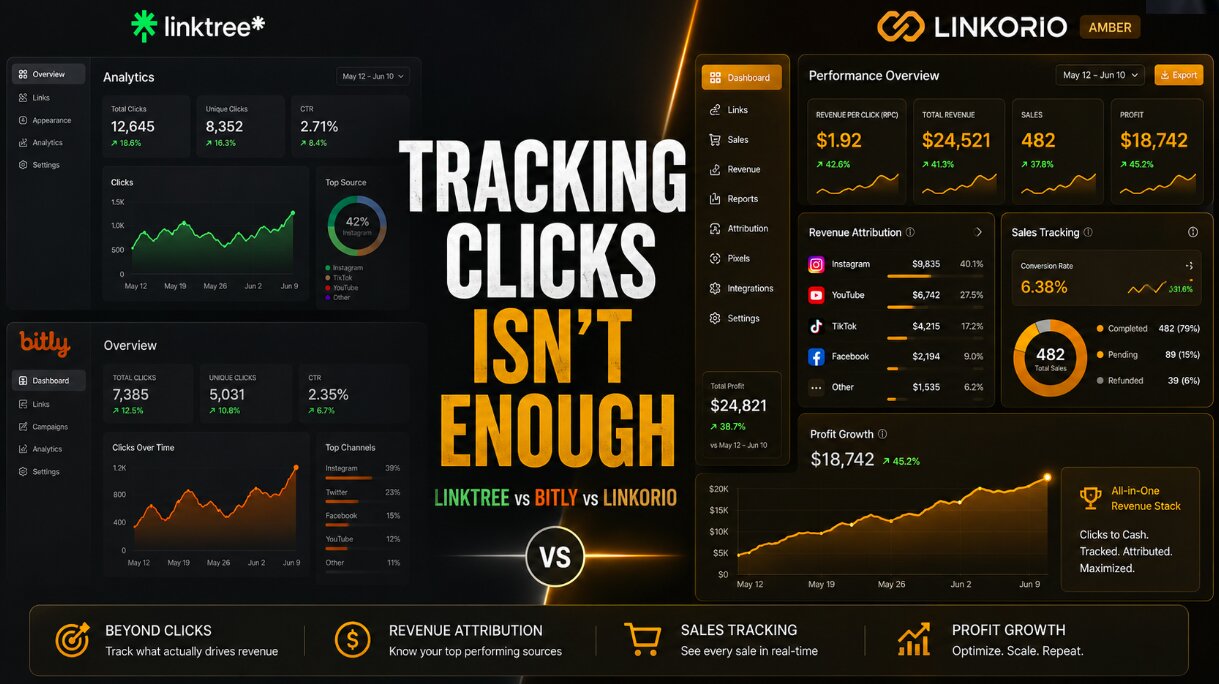
CTR Is a Lie! Why Revenue Per Click Is the Only Metric That Matters in 2026
Marketers love talking about clicks.
Founders love talking about growth.
Neither means much if revenue isn't growing.
A campaign with a 12% CTR can lose money. A campaign with a 1% CTR can print money. Yet most marketing teams still celebrate clicks while ignoring the only metric that pays the bills: Revenue Per Click.
In 2026, the marketers who win won't be the ones generating the most attention. They'll be the ones connecting every link to actual revenue.
The Problem With Click-Obsessed Marketing
For years, marketing analytics has trained teams to focus on activity metrics.
Dashboards are filled with:
- Click-through rates
- Impressions
- Traffic volume
- Engagement percentages
- Session counts
These numbers feel important because they're easy to measure.
They're also easy to misunderstand.
A campaign can generate thousands of visitors and still produce almost no revenue. Another campaign can attract a fraction of the traffic and become a company's most profitable acquisition channel.
The issue isn't that clicks are useless.
The issue is that clicks don't tell you whether money was made.
Vanity Metrics Create False Confidence
CTR is often treated as proof that marketing is working.
But CTR only measures whether someone clicked.
It doesn't tell you:
- Whether they purchased
- How much they spent
- Whether they became a customer
- Whether the campaign was profitable
This creates a dangerous gap between marketing performance and business performance.
Teams celebrate engagement while founders wonder why revenue hasn't moved.
Attribution Breaks When Revenue Isn't Connected to Links
Most businesses can tell you how many visitors a campaign generated.
Far fewer can tell you exactly how much revenue those visitors produced.
That's where revenue attribution breaks down.
Traditional reporting often stops at the click.
The customer journey continues, but the connection between the original link and the eventual purchase disappears.
Without revenue attribution, marketers optimize for visibility instead of profitability.
And profitability is the only thing that keeps the lights on.
Why CTR Became the Default Metric
CTR became popular because it was easy to track.
Long before modern attribution systems existed, advertising platforms could reliably measure impressions and clicks.
Revenue was harder.
Tracking purchases across channels, campaigns, creators, and devices required infrastructure most companies didn't have.
So marketers optimized the metrics they could see.
Over time, CTR became a shortcut for performance.
The problem is that what was once a practical measurement evolved into a flawed success metric.
Today, platforms still highlight clicks because clicks happen inside their ecosystem.
Revenue happens inside yours.
And those are not the same thing.
The Hidden Cost of Optimizing for Clicks
Every optimization strategy creates incentives.
When teams optimize for CTR, they naturally prioritize tactics that increase clicks.
That often leads to:
- Sensational headlines
- Misleading offers
- Curiosity-driven creative
- Low-quality traffic sources
These tactics can increase engagement while decreasing profitability.
Consider two traffic sources:
Source A
- 10,000 visitors
- 12% CTR
- $2,000 revenue
Source B
- 1,000 visitors
- 1.5% CTR
- $5,000 revenue
Most dashboards would make Source A look like the winner.
Your bank account would disagree.
AI Traffic Makes the Problem Worse
As AI-generated content floods search engines and social platforms, attention metrics are becoming less reliable.
More content creates more clicks.
More clicks do not automatically create more buyers.
AI can generate traffic at scale.
It cannot guarantee purchasing intent.
This makes revenue attribution more important than ever.
The ability to identify which links generate actual sales is quickly becoming a competitive advantage.
Revenue Per Click Explained
Revenue Per Click (RPC) measures how much revenue each click generates.
Instead of asking, "Did someone click?"
RPC asks, "How much money did that click produce?"
The formula is simple:
Revenue Per Click = Total Revenue ÷ Total Clicks
Example:
- Revenue generated: $10,000
- Total clicks: 2,000
Revenue Per Click = $5
That means every click is worth an average of $5 in revenue.
Simple.
Powerful.
Actionable.
Why Revenue Per Click Changes Everything
Revenue Per Click aligns marketing directly with business outcomes.
Instead of optimizing for activity, teams optimize for value.
RPC reveals:
- Which campaigns generate revenue
- Which creators drive buyers instead of browsers
- Which affiliates produce profitable customers
- Which content converts attention into sales
- Which traffic sources deserve more budget
Revenue Per Click transforms marketing from a traffic-generation function into a revenue-generation function.
CTR vs Revenue Per Click
The difference between CTR and Revenue Per Click is the difference between measuring attention and measuring outcomes.
MetricCTRRevenue Per Click (RPC)
Measures | Click engagement | Revenue generated per click
Focus | Attention | Profitability
Useful For | Creative testing | Budget allocation
Reveals Purchase Intent | No | Yes
Shows Revenue Impact | No | Yes
Helps Scale Winning Channels | Limited | Directly
Founder-Friendly | Rarely | Absolutely
Predicts Business Growth | Weakly | Strongly
A high CTR does not guarantee revenue.
A high Revenue Per Click almost always deserves attention.
How to Track Revenue Per Click Across Every Link
Most analytics tools were built for traffic reporting.
Not revenue attribution.
That's why many businesses still struggle to calculate RPC accurately.
The Traditional Approach
Most teams rely on:
- Google Analytics
- UTM parameters
- Spreadsheet exports
- Manual attribution reports
This process usually answers:
"Where did visitors come from?"
It rarely answers:
"Which link generated the most money?"
Why Existing Tools Fall Short
Google Analytics can show sessions and conversions.
It often struggles to reveal revenue performance at the individual-link level.
Bitly can track clicks.
It cannot tell you how much revenue those clicks produced.
UTM tracking identifies traffic sources.
It does not automatically reveal profitability.
This leaves marketers with fragmented data and incomplete insights.
Connecting Links to Revenue
To calculate Revenue Per Click accurately, every click needs to stay connected to the revenue it eventually generates.
That requires:
- Link tracking
- Revenue attribution
- Campaign-level reporting
- Revenue visibility across channels
Once those pieces are connected, RPC becomes one of the most powerful metrics in your entire stack.
The Metrics That Actually Matter in 2026
The next generation of marketing analytics is moving away from attention metrics and toward revenue metrics.
Founders increasingly want answers to questions like:
- Which campaign generated the most revenue?
- Which creator produced the highest-value customers?
- Which affiliate delivered profitable sales?
- Which content deserves additional investment?
- Which links are creating customers instead of visitors?
The most useful metrics in 2026 include:
- Revenue Per Click (RPC)
- Customer Acquisition Cost (CAC)
- Return on Ad Spend (ROAS)
- Customer Lifetime Value (LTV)
- Revenue Attribution by Channel
- Revenue Attribution by Link
Notice what's missing.
CTR isn't at the top of the list.
Because attention is only valuable when it produces outcomes.
Turn Every Link Into a Revenue Signal
This is where Linkorio comes in.
Linkorio was built around a simple idea:
Every link should be accountable for revenue.
Instead of tracking clicks in isolation, Linkorio connects links directly to revenue so marketers can see exactly which campaigns, creators, affiliates, emails, and content pieces generate sales.
That means you can:
- Measure Revenue Per Click across channels
- Identify your most profitable traffic sources
- Improve revenue attribution
- Eliminate guesswork from budget decisions
- Scale what actually makes money
Unlike traditional marketing analytics tools that stop at traffic reporting, Linkorio closes the gap between clicks and revenue.
The result is clear visibility into what drives growth and what merely creates activity.
And you don't need a complicated analytics setup to get there.
Conclusion
For years, marketing teams have been rewarded for generating clicks.
Founders have been rewarded for generating revenue.
Those goals are not always aligned.
CTR measures attention.
Revenue Per Click measures business impact.
One tells you what people noticed.
The other tells you what people bought.
As AI-generated traffic increases and acquisition channels become more crowded, revenue attribution will become the defining advantage for growth-focused teams.
The marketers who win in 2026 won't be the ones chasing the most clicks.
They'll be the ones tracking which clicks actually make money.
Clicks are activity. Revenue is outcomes.
Start measuring the outcome.