
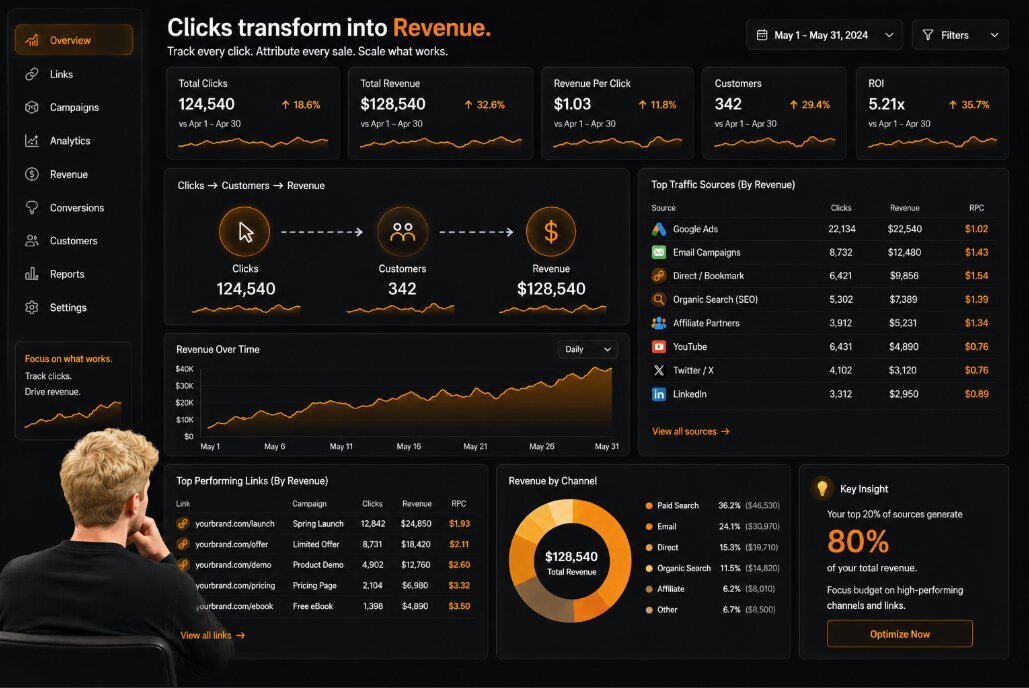
Most marketing teams can tell you how many people clicked. Fewer can tell you what those clicks were worth.
That difference matters. A campaign with thousands of clicks can look successful while producing weak revenue. Meanwhile, a smaller traffic source can quietly become one of your best growth channels.
Revenue Per Click (RPC) changes the question from “How much attention did we get?” to “How much revenue did that attention create?”
Why Traditional Marketing Metrics Don’t Tell the Full Story
Marketing teams have spent years optimizing around metrics like:
- Click-through rate
- Website traffic
- Impressions
- Conversion rate
- Cost per click
These numbers are useful. They show activity.
The problem is that activity does not always equal business impact.
A campaign can generate 50,000 clicks and produce disappointing sales. Another campaign can generate 2,000 clicks and bring in customers worth far more.
The difference is traffic quality.
A click from someone who never buys is not equal to a click from someone who becomes a high-value customer.
Yet many businesses still make decisions based on surface-level performance:
“Which campaign got the most clicks?”
“Which channel brought the most visitors?”
“Which ad had the highest engagement?”
Those questions are easy to answer. They are also incomplete.
The better question is:
Which marketing activity creates revenue?
That is where revenue attribution and RPC become important.
Revenue Per Click (RPC) Definition: What It Is
Revenue Per Click measures how much revenue is generated from each click a marketing link receives.
It connects marketing activity directly to business outcomes.
The formula is simple:
Revenue ÷ Clicks = Revenue Per Click
For example:
Campaign A
- 10,000 clicks
- $2,000 revenue
RPC:
$2,000 ÷ 10,000 = $0.20 per click
Campaign B
- 2,000 clicks
- $3,000 revenue
RPC:
$3,000 ÷ 2,000 = $1.50 per click
Campaign A generated more traffic.
Campaign B generated more value.
If you only looked at clicks, you would probably invest more into Campaign A.
If you looked at RPC, the decision becomes obvious.
The goal is not to find the source with the most clicks. The goal is to find the source where each click is worth more.
Why Revenue Per Click Is the Ultimate Marketing Metric
Most marketing metrics measure one part of the journey.
Clicks measure interest.
Conversions measure actions.
Revenue measures outcomes.
RPC connects the entire path.
It helps answer questions that traditional reporting often misses:
- Which links actually make money?
- Which channels attract valuable customers?
- Which campaigns deserve more budget?
- Which traffic sources create profitable growth?
This is why RPC is becoming a stronger marketing performance metric for businesses that care about revenue instead of attention.
A social post with 100,000 views might create less value than a niche article with 5,000 readers.
A paid campaign with a lower click volume might outperform a larger campaign if those clicks produce better customers.
Revenue attribution is about understanding the difference between activity and impact.
Revenue Per Click vs Traditional Marketing Metrics
Different metrics answer different questions.
The mistake is treating all metrics as if they measure business success.
Click-Through Rate (CTR)
CTR answers:
“How many people clicked?”
It does not answer:
“How much revenue did those clicks create?”
A high CTR can be a sign that your message attracts attention. But attention alone does not pay the bills.
Traffic
Traffic answers:
“How many visitors arrived?”
It does not show:
- Buyer intent
- Customer value
- Revenue potential
A website receiving 100,000 visitors is not automatically outperforming a website receiving 10,000 visitors.
The better question is what those visitors produce.
Cost Per Click (CPC)
CPC answers:
“How much did each click cost?”
Useful, but incomplete.
A cheap click is not always a good click.
A $0.20 click that never converts is more expensive than a $2 click that creates a profitable customer.
Conversion Rate
Conversion rate answers:
“What percentage of visitors completed an action?”
It is helpful, but it ignores revenue size.
A campaign creating fewer purchases can still win if those customers spend more.
Revenue Per Click
RPC answers:
“How much revenue did each click generate?”
That makes it closer to the actual business outcome.
| Metric | What It Measures | What It Misses |
| Traffic | Visitors | Revenue quality |
| CTR | Click interest | Customer value |
| CPC | Cost of clicks | Profitability |
| Conversion Rate | Buyer percentage | Revenue size |
| RPC | Revenue per click | Direct business impact |
How to Use RPC to Improve Marketing Decisions
Track Links, Not Just Campaigns
Many businesses stop tracking at the campaign level.
That creates blind spots.
A single campaign can contain:
- Multiple ads
- Different landing pages
- Several creators
- Multiple links
- Different audiences
Knowing a campaign generated revenue is useful.
Knowing which exact link created that revenue is much more valuable.
Track important links across:
- Ads
- Social posts
- Emails
- Partnerships
- Landing pages
- Affiliate campaigns
Every link is a potential source of revenue data.
Find Your Highest-Value Traffic Sources
RPC helps identify where your best customers actually come from.
A channel with fewer visitors might be your strongest acquisition source.
Examples:
A newsletter with 2,000 subscribers may outperform a social account with 100,000 followers.
A small creator may generate more revenue than a large influencer.
A product comparison page may outperform a high-traffic blog post.
Without revenue attribution, these opportunities are easy to miss.
With link tracking analytics, businesses can see which sources create actual value.
Allocate Budget Based on Revenue
Many teams optimize based on:
- More clicks
- More impressions
- More engagement
- Lower CPC
But growth decisions should be based on:
- Revenue generated
- Customer quality
- Revenue Per Click
The shift is simple:
Instead of asking:
“Which channel gets the most traffic?”
Ask:
“Which channel creates the most revenue?”
That change affects everything:
- Where you spend money
- Which campaigns you scale
- Which content you create
- Which partnerships you pursue
How Linkorio Helps Turn Click Data Into Revenue Data
Most analytics platforms can tell you where visitors came from.
The harder question is what happened after the click.
Linkorio helps businesses connect links to revenue outcomes, making it easier to understand which campaigns, channels, and sources actually generate sales.
Instead of optimizing for clicks alone, marketers can focus on the links that create measurable business results.
Common Mistakes When Measuring Marketing Performance
Many companies make the same measurement mistakes:
1. Celebrating traffic without checking revenue
More visitors do not automatically mean more customers.
2. Optimizing for cheap clicks
Low-cost traffic can still be low-value traffic.
3. Measuring channels without link-level data
A channel can look successful while certain campaigns inside it fail.
4. Ignoring customer value
A campaign producing fewer customers may create more revenue.
The problem is rarely a lack of data.
The problem is focusing on the wrong data.
Final Thoughts
Clicks are a starting point.
Revenue is the goal.
The best marketing teams do not just measure attention. They measure what that attention is worth.
Revenue Per Click helps turn marketing data into better decisions by showing which clicks actually create growth.
The future of marketing measurement is not more dashboards.
It is clearer answers about what drives revenue.
Frequently Asked Questions
What is Revenue Per Click (RPC)?
Revenue Per Click is a marketing metric that shows how much revenue is generated from each click. It is calculated by dividing total revenue by the number of clicks.
How is RPC different from conversion rate?
Conversion rate measures how many people complete an action. RPC measures the revenue value of each click, which includes customer value and purchase size.
Why are clicks not enough to measure marketing success?
Clicks show interest but not business results. A high-click campaign can produce little revenue, while a smaller campaign can generate highly valuable customers.
Can RPC help with marketing attribution?
Yes. RPC works with revenue attribution by connecting clicks, links, and campaigns to actual revenue outcomes.
What businesses benefit from tracking RPC?
SaaS companies, ecommerce brands, agencies, creators, and performance marketers can use RPC to identify profitable traffic sources and improve marketing decisions.