
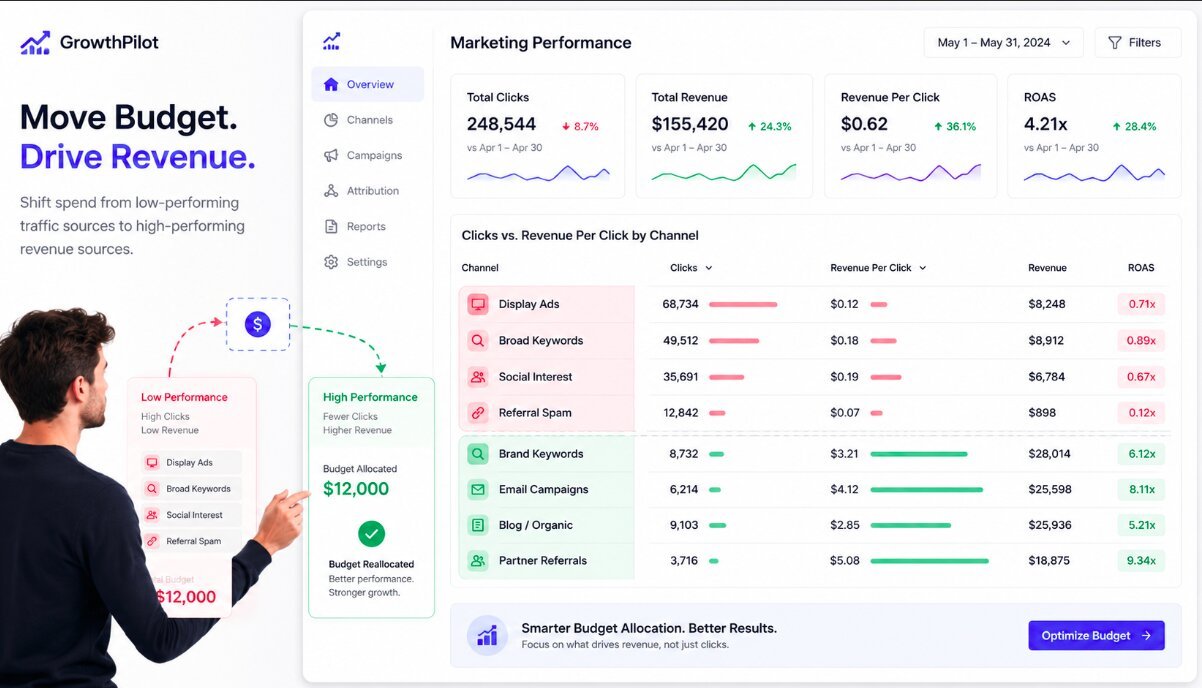
I stopped putting money behind the channels that brought the most clicks.
Instead, I followed the numbers that showed which clicks actually created revenue.
The result was uncomfortable at first. Some of the channels that looked like winners were producing almost nothing. Smaller traffic sources were quietly generating customers.
That was when I started focusing on Revenue Per Click instead of traffic volume.
Because more clicks do not always mean more growth.
Sometimes they just mean more noise.
I Was Optimizing Marketing Based on the Wrong Numbers
For years, marketers have been trained to watch the same dashboard metrics.
Traffic.
Clicks.
CTR.
Engagement.
Cost per click.
The problem?
Most of these numbers answer the wrong questions.
They tell you what happened before revenue.
They do not tell you what created revenue.
A campaign can generate thousands of visitors and still produce weak results.
A paid ad can have a low CPC and attract people who never buy.
A social post can get massive engagement but bring in zero customers.
The mistake is assuming attention equals business value.
It doesn't.
The Problem With Vanity Metrics
Metrics like clicks, impressions, and engagement are easy to celebrate because they move quickly.
Revenue usually moves slower.
That creates a dangerous gap.
Teams start optimizing for what looks good in a dashboard instead of what improves the business.
A cheap click feels like a win.
A high-traffic channel feels important.
A popular post feels successful.
But the real question is:
Which traffic actually makes money?
That requires better revenue attribution.
Without it, marketing decisions become educated guesses.
I Switched My Budget Decisions to Revenue Per Click
The biggest change I made was switching from traffic-based decisions to Revenue Per Click decisions.
The concept is simple:
Revenue Per Click = Revenue generated ÷ Number of clicks
Instead of asking:
"How many people clicked?"
I started asking:
"How much revenue did each click create?"
The difference changed how I evaluated every channel.
Consider two campaigns.
Channel A
- 10,000 clicks
- $2,000 revenue
Channel B
- 1,500 clicks
- $6,000 revenue
A traditional marketing dashboard would make Channel A look stronger.
More traffic.
More activity.
More volume.
But Channel B is clearly the better investment.
Every click from Channel B is worth significantly more.
The traffic quality is higher.
The audience is more valuable.
The marketing is more efficient.
This is what RPC reveals that CTR, CPC, and clicks alone hide.
What Happened After I Followed Revenue Instead of Traffic
The first thing I noticed was that some assumptions were wrong.
The channels we thought were working were not always the channels creating customers.
Before focusing on RPC, budget decisions looked like this:
- Spend more on channels with the most traffic
- Promote content with the highest engagement
- Support campaigns with the lowest cost per click
- Judge success by volume
The problem was obvious after looking at revenue data.
Some sources were generating attention.
Others were generating customers.
Those are not the same thing.
The Shift: From Traffic Sources to Revenue Sources
After tracking performance at the link level, the strategy changed.
Instead of asking:
"Which channel gets the most visitors?"
We asked:
"Which links create the most revenue?"
That changed how we evaluated:
- Newsletter links
- Paid ads
- Partner campaigns
- Social posts
- Content pages
A newsletter with a smaller audience started outperforming larger channels because the audience had stronger buying intent.
A partner campaign with fewer clicks produced higher-value customers.
A product comparison page generated fewer visitors but more sales.
The winners were not always the loudest channels.
They were the profitable ones.
Why Link-Level Tracking Changed the Decision Process
Most reporting stops too early.
Google Analytics can show traffic.
Ad platforms can show clicks.
UTM tracking can show campaign sources.
Useful information.
But the final question remains:
Which specific link created revenue?
That is where link tracking analytics becomes valuable.
A single campaign can contain dozens of links.
Some create customers.
Some create empty traffic.
Without link-level data, they look identical.
With better attribution, you can see what deserves more investment.
How to Move Your Marketing Budget Using RPC
Changing budget allocation does not require a complicated process.
It starts with measuring the right things.
Measure Every Traffic Source
Every important traffic source should have clear tracking.
This includes:
- Campaign links
- Landing pages
- Partner links
- Social campaigns
- Email campaigns
- Paid advertisements
If multiple sources share the same destination without tracking, attribution becomes unclear.
The goal is to connect:
Click → Customer → Revenue
Once that connection exists, budget decisions become much easier.
Compare Revenue Quality, Not Just Traffic Quantity
Traffic volume can be misleading.
Two channels can produce completely different outcomes.
One might bring:
- 50,000 visitors
- Low purchase intent
- Weak revenue
Another might bring:
- 5,000 visitors
- Strong buying intent
- High customer value
The second channel is usually the better opportunity.
Good marketing is not about maximizing visitors.
It is about attracting valuable customers.
That is why traffic quality matters more than traffic volume.
Reallocate Budget Toward Winners
A simple RPC-based process looks like this:
- Identify highest-RPC sources
- Reduce spending on low-RPC sources
- Increase investment in profitable channels
- Continue testing and measuring
The goal is not to find one perfect channel.
The goal is building a system that consistently identifies what works.
Marketing becomes less about guessing.
More about improving.
The Metrics I Stopped Using as My Main Decision Drivers
I still look at traditional metrics.
They have context.
But they are no longer the deciding factor.
| Metric | What It Tells You | Problem |
| Traffic | How many visitors arrived | Not revenue |
| CTR | How many people clicked | Not buyers |
| CPC | Cost of clicks | Not customer value |
| Conversion Rate | Percentage buying | Misses revenue size |
| RPC | Revenue per click | Connects traffic to money |
The biggest mistake is treating every metric like it has equal importance.
It doesn't.
A metric matters when it helps make better decisions.
Common Marketing Attribution Mistakes
Many businesses waste budget because their reporting is disconnected.
Common mistakes include:
- Optimizing for clicks instead of customers
- Choosing channels based on traffic volume
- Ignoring revenue after conversion
- Comparing campaigns without link-level data
- Scaling sources before proving profitability
The goal of marketing ROI tracking is not collecting more numbers.
It is understanding which numbers actually affect revenue.
Stop Guessing Where Your Marketing Budget Works
Linkorio helps marketers and founders track which links generate revenue and understand where marketing budget actually creates results.
Instead of relying only on clicks, impressions, and campaign dashboards, teams can identify which sources produce customers.
That means better visibility into:
- Profitable links
- High-value traffic sources
- Winning campaigns
- Revenue-generating channels
The goal is simple:
Know what works before spending more.
Conclusion
The goal is not to buy more clicks.
The goal is to buy more profitable clicks.
Most marketing teams are surrounded by data.
The challenge is knowing which data should drive decisions.
Revenue Per Click changes the conversation.
It moves marketing away from traffic volume and toward business impact.
The companies that grow efficiently are not the ones chasing the biggest numbers.
They are the ones understanding which clicks become customers.
Building a revenue-first marketing system starts with knowing exactly where your budget creates revenue.
Frequently Asked Questions
What is Revenue Per Click?
Revenue Per Click (RPC) measures how much revenue each click generates. It is calculated by dividing total revenue by total clicks.
Why is Revenue Per Click better than CTR?
CTR only shows how many people clicked. RPC shows whether those clicks created revenue, making it a stronger metric for business decisions.
Can a low-traffic channel outperform a high-traffic channel?
Yes. A smaller channel with higher customer intent can generate significantly more revenue than a large channel with poor traffic quality.
How does link tracking improve marketing attribution?
Link tracking connects specific campaigns, pages, and sources to revenue. This helps identify which marketing activities actually create customers.
Should marketers stop tracking clicks and traffic?
No. These metrics still provide context. The problem is using them as the final measure of success instead of connecting them to revenue.
How does RPC help with marketing budget optimization?
RPC shows which sources generate the most revenue per click, helping teams move budget toward profitable channels and away from inefficient traffic.