
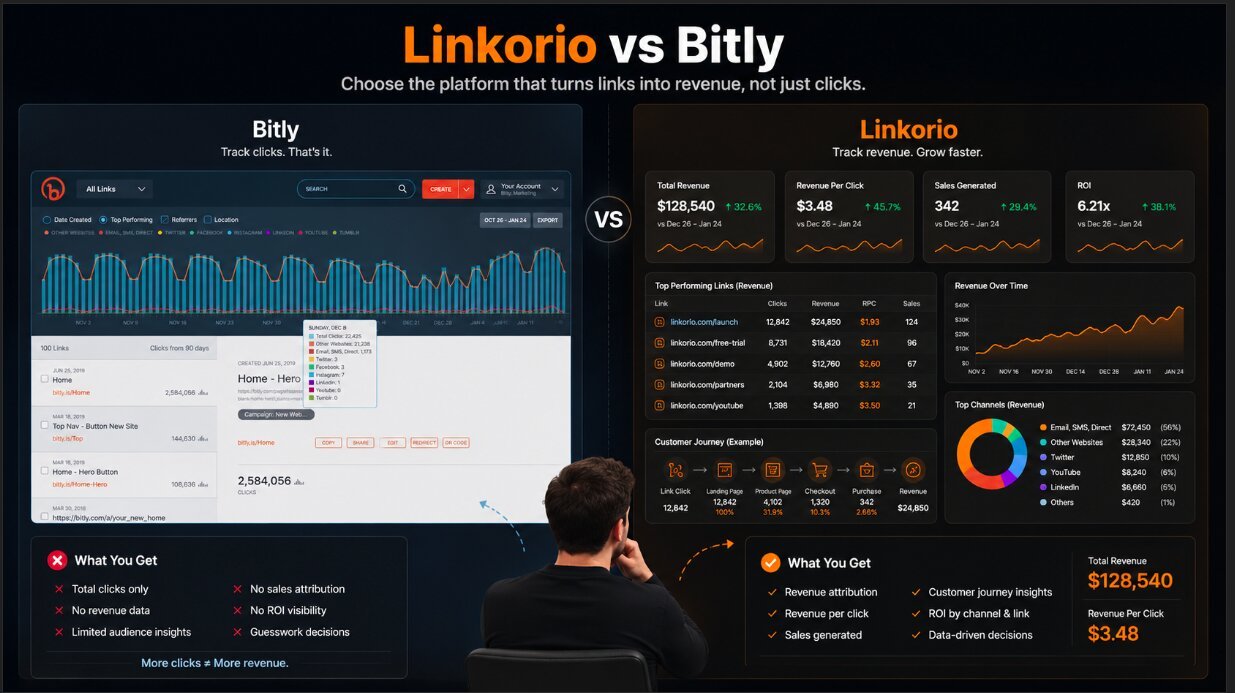
Free link shorteners are great — until your business depends on knowing what actually makes money.
A link getting thousands of clicks does not mean it is creating customers.
That is where the difference between Linkorio vs Bitly becomes important.
Basic link tracking tells you what happened.
Revenue attribution tells you what worked.
For growing businesses, the question is no longer:
"How many people clicked?"
It becomes:
"Which links created revenue?"
When Link Shorteners Stop Being Enough
Tools like Bitly became popular for a simple reason.
They solved a real problem.
Long URLs were messy.
Sharing links across campaigns was difficult.
Marketers needed a cleaner way to manage links and understand basic performance.
Traditional link shorteners provide useful information:
- Number of clicks
- Geographic location
- Device data
- Traffic volume
- Basic engagement insights
For many early-stage campaigns, that is enough.
But businesses eventually hit a wall.
The problem starts when marketing decisions depend on revenue.
A founder running paid campaigns, partnerships, influencer campaigns, or content marketing needs answers beyond clicks.
They need to know:
- Which links generated sales?
- Which campaigns created customers?
- Which partners drove revenue?
- Which traffic sources deserve more budget?
A click is only the beginning of the customer journey.
It is not the final outcome.
The Problem With Click-Based Reporting
Most analytics tools are good at measuring activity.
They show:
"People clicked this link."
But they often do not show:
"Those clicks generated $X in revenue."
That gap creates bad decisions.
A link with 20,000 clicks can look successful.
A link with 500 clicks can look insignificant.
But what if the smaller link created 10 times more revenue?
Without attribution, you would never know.
The issue is not tracking clicks.
The issue is stopping at clicks.
Linkorio vs Bitly: Click Tracking vs Revenue Tracking
The difference between Linkorio and Bitly comes down to what you are trying to measure.
Bitly focuses on link management and click analytics.
It helps answer:
"How many people clicked this link?"
That is valuable.
Linkorio focuses on connecting links to business outcomes.
It helps answer:
"Which links actually created revenue?"
The difference matters when marketing spend increases.
Bitly Is Built for Link Management
Bitly is useful for:
- Shortening URLs
- Sharing cleaner links
- Monitoring click activity
- Understanding basic engagement
For simple campaigns, these features can be enough.
But click data alone does not explain profitability.
A marketer may know:
"This campaign received 5,000 clicks."
But they still need to know:
"Did those clicks create customers?"
Linkorio Focuses on Revenue Attribution
Linkorio is built around understanding the relationship between links and revenue.
It helps businesses track:
- Link-to-sale performance
- Revenue attribution
- Revenue Per Click
- Which campaigns create actual business results
The goal is not replacing click tracking.
The goal is adding the missing layer:
What happened after the click?
The Difference Between Measuring Clicks and Measuring Money
Clicks measure attention.
Revenue measures value.
The connection between them is Revenue Per Click (RPC).
The formula is simple:
Revenue ÷ Clicks = Revenue Per Click
RPC shows how much revenue each click generates.
Consider two links.
Link A
- 10,000 clicks
- $500 revenue
Link B
- 1,000 clicks
- $5,000 revenue
A click-focused dashboard would make Link A look better.
It generated more traffic.
More activity.
More engagement.
But Link B is the stronger marketing asset.
Why?
Because each click is worth more.
The traffic quality is higher.
The audience is more valuable.
This is why businesses need more than basic link tracking analytics.
They need context.
How to Know When You Need More Than a Free Link Shortener
A free link shortener works well when you only need basic visibility.
But there are signs your business needs more advanced tracking.
You Need Revenue Attribution, Not Just Click Counts
You probably need deeper tracking if:
- Multiple campaigns use different links
- Paid advertising spend is increasing
- Influencers or partners send traffic
- Content performance varies widely
- You need to justify marketing investment
At this stage, knowing clicks is not enough.
You need to understand which activities create revenue.
A business cannot scale based on assumptions.
It needs evidence.
Track Every Revenue-Generating Link
Every important marketing asset should have measurable performance.
This includes:
- Ads
- Social posts
- Newsletters
- Partnerships
- Affiliate campaigns
- Product pages
A common mistake is using one generic link everywhere.
For example:
A SaaS company promotes a product through:
- A LinkedIn post
- A newsletter
- A partner article
- A paid campaign
If every visitor lands through the same untracked URL, attribution disappears.
Separate tracking creates clarity.
You can see which sources deserve attention.
Move From Traffic Decisions to Revenue Decisions
Most teams ask:
"Which link got the most clicks?"
A revenue-focused team asks:
"Which link created the most revenue?"
That mindset changes everything.
The best-performing link is not always the one with the most visitors.
It is the one that creates the strongest business outcome.
Link Tracking vs Revenue Attribution
| Feature | Bitly | Linkorio |
| Link shortening | Yes | Yes |
| Click tracking | Yes | Yes |
| Basic analytics | Yes | Yes |
| Revenue attribution | Limited | Yes |
| Revenue Per Click tracking | No | Yes |
| Link-to-sale visibility | No | Yes |
| Marketing budget decisions | Limited | Data-driven |
The comparison is not about whether click tracking matters.
It does.
The question is whether clicks are enough to make profitable decisions.
For growing businesses, they usually are not.
Why Google Analytics and UTM Tracking Still Have Limits
Google Analytics and UTM tracking are useful tools.
They help organize traffic sources and campaign data.
But many businesses still struggle with one question:
"What specifically created revenue?"
UTMs can tell you where traffic came from.
They do not always reveal the full financial impact of each link.
A campaign can have strong traffic numbers and weak sales.
Another can have fewer visitors and stronger revenue.
The difference is understanding what happens after the click.
Your Links Should Tell You More Than Click Numbers
Linkorio helps founders and marketers understand which links generate revenue, not just traffic.
Instead of only measuring clicks, businesses can connect marketing activity to actual outcomes.
This makes it easier to identify:
- Profitable campaigns
- Valuable partnerships
- High-performing content
- Revenue-generating traffic sources
The goal is simple:
Stop optimizing for activity.
Start optimizing for growth.
Conclusion
Free tools help you count clicks.
Revenue-focused tools help you understand growth.
A link with more clicks is not automatically better.
A link with more revenue impact is.
The biggest mistake businesses make is confusing attention with performance.
Clicks are useful.
But clicks without revenue context can lead you in the wrong direction.
The goal is not more clicks.
The goal is more profitable clicks.
That is the difference between basic link tracking and revenue attribution.
Frequently Asked Questions
What is the difference between Linkorio and Bitly?
Bitly focuses on link shortening and click analytics. Linkorio focuses on connecting links to revenue outcomes through attribution and Revenue Per Click tracking.
Is Bitly enough for marketing campaigns?
Bitly can be enough for basic link tracking. Businesses running serious campaigns often need additional revenue attribution to understand which links create customers.
Why are clicks not enough to measure marketing success?
Clicks show interest but not business impact. A high-click link can generate little revenue, while a smaller traffic source can produce valuable customers.
What is Revenue Per Click?
Revenue Per Click measures the revenue generated from each click. It helps marketers compare traffic sources based on value, not just volume.
Can Linkorio replace Google Analytics?
Linkorio and Google Analytics solve different problems. Google Analytics helps understand traffic behavior, while Linkorio focuses on connecting links to revenue.
When should a business move beyond a free link shortener?
When marketing decisions depend on knowing which links, campaigns, and channels create sales, basic click reporting is no longer enough.