
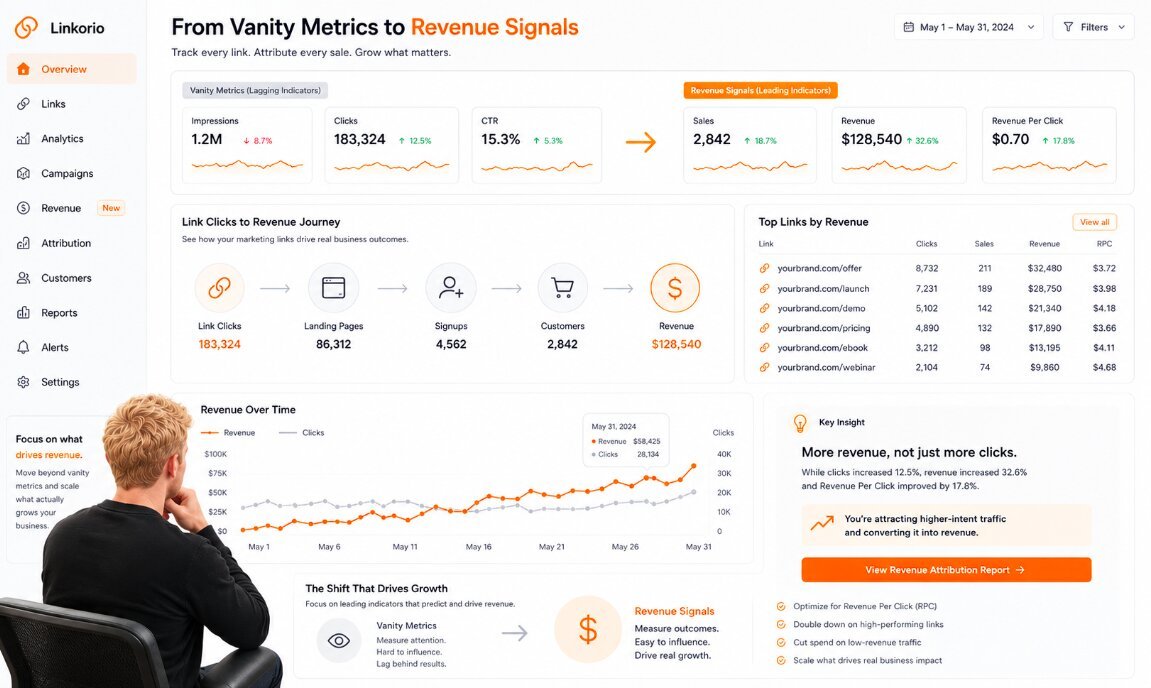
Most marketers know how many people saw their content. Far fewer know if those people created revenue.
That is the problem with modern marketing measurement: attention is easy to count, but business impact is harder to prove.
A post can go viral and create zero customers. A small campaign with limited reach can quietly become one of your biggest revenue drivers.
The difference comes down to finding the right revenue signals in marketing.
Why Counting Eyeballs Creates Bad Marketing Decisions
Marketing teams have access to more data than ever.
They can see:
- Impressions
- Reach
- Followers
- Likes
- Views
- Clicks
- Website traffic
These numbers feel useful because they show activity.
But activity is not the same as impact.
A social post with 500,000 impressions might create no meaningful sales.
A newsletter sent to 5,000 people might generate dozens of high-value customers.
Both campaigns created attention.
Only one created business results.
This is where many teams get stuck.
They optimize for what is visible:
- More followers
- More engagement
- More traffic
- More clicks
Instead of asking:
“What marketing activity actually creates revenue?”
The enemy is not data.
The enemy is measuring the wrong data.
Vanity metrics can make weak campaigns look successful because they reward attention, not outcomes.
How to Find Real Revenue Signals in Marketing
Revenue signals are the measurable actions that show marketing is contributing to business growth.
They help answer a more important question:
“Did this marketing effort create something valuable?”
Examples of revenue signals include:
- Purchases
- Qualified leads
- Revenue generated
- Customer value
- Revenue Per Click
These metrics connect marketing activity to actual business performance.
A campaign is not valuable because thousands of people saw it.
It is valuable because the right people took action.
This is where Revenue Per Click (RPC) becomes useful.
RPC shows how much revenue each tracked click generates.
The formula:
Revenue ÷ Clicks = Revenue Per Click
Example:
Campaign A
- 50,000 impressions
- 5,000 clicks
- $1,000 revenue
RPC = $0.20
Campaign B
- 5,000 impressions
- 500 clicks
- $2,000 revenue
RPC = $4.00
Campaign A created more visibility.
Campaign B created a stronger revenue signal.
The second campaign attracted fewer people but much more valuable attention.
The goal is not to get more clicks. The goal is to understand which clicks are worth more.
The Difference Between Attention Metrics and Revenue Metrics
Attention metrics answer:
“Did people notice us?”
Revenue metrics answer:
“Did this activity create business value?”
Both matter.
But they solve different problems.
Attention metrics:
- Reach
- Views
- Impressions
- Engagement
- Followers
These tell you whether people are seeing your message.
Revenue metrics:
- Sales
- Revenue generated
- Customer value
- Revenue Per Click
- Conversion quality
These tell you whether your marketing is working.
A SaaS company might celebrate a blog post receiving 50,000 visitors.
But if another article brings only 2,000 visitors and creates 20 enterprise demos, the smaller article is probably more valuable.
An ecommerce brand might celebrate a viral TikTok video.
But if a product comparison page creates more purchases from fewer visitors, that page deserves more attention.
Attention starts the conversation. Revenue proves the conversation mattered.
How to Start Tracking Revenue Signals Instead of Eyeballs
Connect Marketing Actions to Revenue
Every marketing action should have a measurable outcome.
That includes:
- Ads
- Social posts
- Emails
- Partnerships
- Content links
- Product pages
Many companies track campaigns at a high level.
They know:
“Paid ads generated traffic.”
But they cannot answer:
“Which ad created the customer?”
That missing connection makes marketing decisions harder than they need to be.
Revenue attribution closes that gap by connecting marketing activity to actual outcomes.
Track Links, Not Just Campaigns
Campaign-level reporting is useful.
Link-level tracking is where things become actionable.
A single campaign can contain multiple assets:
- Different ads
- Different landing pages
- Different social posts
- Different creators
- Different email placements
Without tracking individual links, you lose the details.
Link-level attribution helps identify:
- Which post created buyers
- Which creator drove sales
- Which email generated revenue
- Which campaign deserves more budget
A link is not just a URL.
It is a measurable path from attention to revenue.
Measure Quality, Not Just Quantity
A common mistake is assuming bigger numbers mean better performance.
They do not.
More traffic does not always mean more revenue.
More followers do not always mean more customers.
More clicks do not always mean better marketing.
Instead, focus on:
- Revenue per click
- Customer value
- Conversion quality
- Profitability
A smaller audience with stronger buying intent can outperform a massive audience that never converts.
This is why marketing attribution matters.
It shows the difference between people who noticed your brand and people who created business value.
Reallocate Budget Based on Revenue Signals
Once you understand which channels create revenue, budget decisions become clearer.
The process is simple:
- Identify profitable channels
- Reduce investment in weak performers
- Scale what creates revenue
- Continue measuring results
Instead of asking:
“Which channel has the most traffic?”
Ask:
“Which channel creates the most valuable customers?”
This shift changes how teams think about marketing performance.
Marketing Metrics Comparison
| Metric | What It Measures | Problem |
| Impressions | Visibility | Doesn't show intent |
| Followers | Audience size | Doesn't show buyers |
| Clicks | Interest | Doesn't show revenue |
| Conversion Rate | Purchase percentage | Can ignore customer value |
| RPC | Revenue per click | Shows business impact |
Stop Measuring Attention Without Measuring Revenue
Most marketing dashboards tell you what happened.
Fewer tell you why it happened.
Linkorio helps businesses connect clicks, links, and campaigns to actual revenue so teams can understand which marketing efforts are producing real results.
Instead of guessing based on traffic numbers, marketers can see which actions create customers.
The goal is not collecting more data.
The goal is finding the data that helps you make better decisions.
Conclusion: Find the Signals That Lead to Revenue
Marketing is not a competition for the most attention.
It is a system for creating business growth.
Impressions, reach, and clicks can show that people noticed you.
But revenue signals show whether that attention mattered.
The best marketers do not chase more eyeballs.
They find the signals that lead to revenue and invest more in what works.
Frequently Asked Questions
What are revenue signals in marketing?
Revenue signals are measurable actions that show marketing activity is creating business value. Examples include purchases, qualified leads, revenue generated, customer value, and Revenue Per Click.
Why are vanity metrics bad for marketing decisions?
Vanity metrics like impressions, followers, and likes measure attention but often fail to show whether that attention creates customers or revenue.
What is Revenue Per Click (RPC)?
Revenue Per Click measures how much revenue is generated from each click. Formula: Revenue ÷ Clicks = Revenue Per Click
How is RPC different from clicks or traffic?
Clicks and traffic show activity. RPC shows the financial value of that activity by connecting clicks to revenue outcomes.
Why does link tracking improve marketing attribution?
Link tracking shows which specific sources, campaigns, posts, or partners are generating revenue instead of only showing general traffic numbers.