
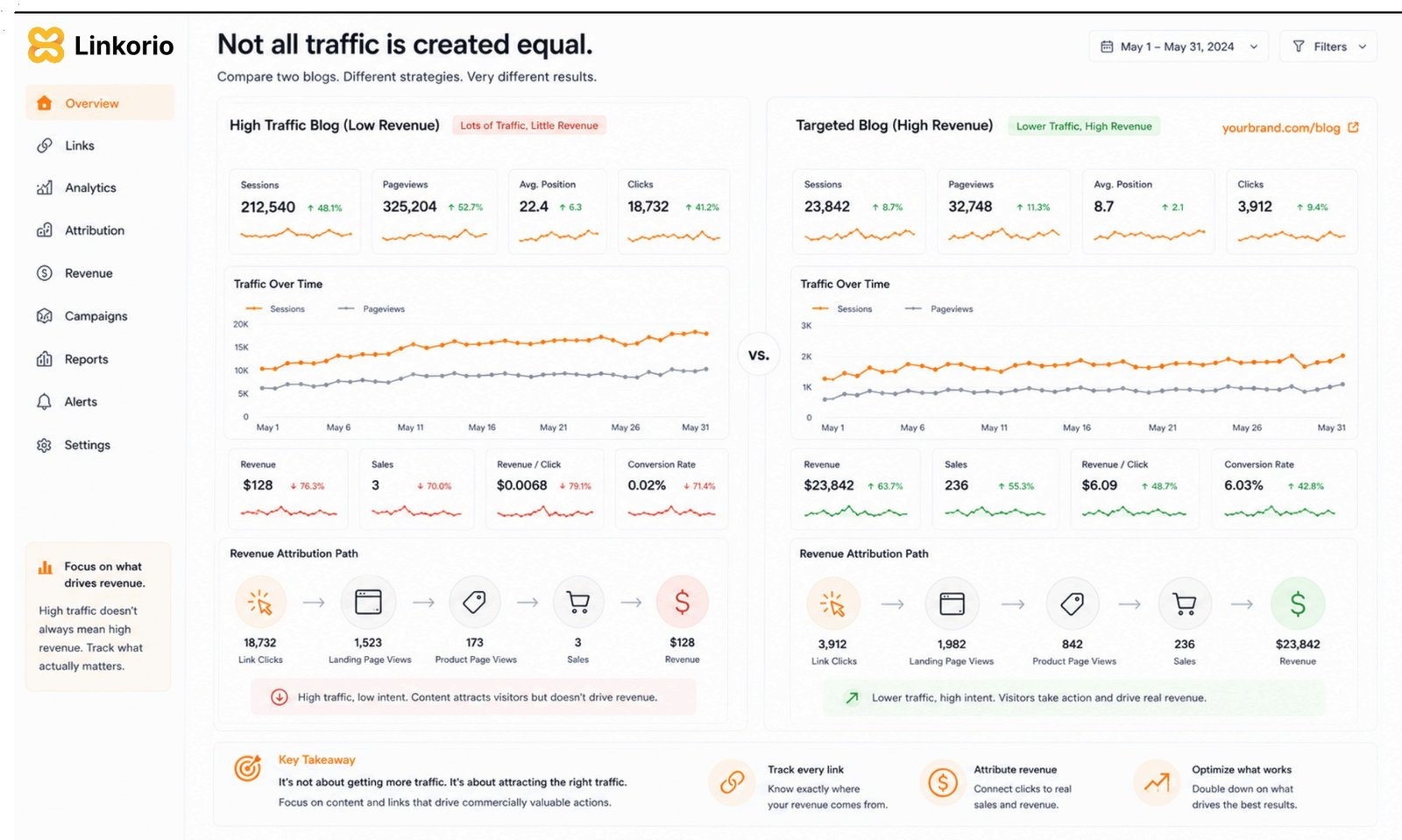
Your blog doesn't have a traffic problem. It has a low RPC problem.
Many companies assume that more visitors automatically lead to more customers. They celebrate rankings, pageviews, and organic growth while revenue barely moves. The reality is simple: a blog can rank for hundreds of keywords, attract thousands of readers, and still produce almost no business value if its Revenue Per Click (RPC) is low.
The goal of content marketing isn't to attract everyone.
It's to attract the people who buy.
Why High-Traffic Blogs Still Fail
Most content teams measure success with numbers that are easy to find.
Typical SEO dashboards focus on:
- Organic traffic
- Keyword rankings
- Sessions
- Pageviews
- Time on page
Those metrics aren't useless.
They're just incomplete.
A blog can gain 100,000 monthly visitors while generating only a handful of customers. Another blog with one-fifth the traffic can quietly become the company's biggest acquisition channel.
Why?
Because visibility doesn't automatically create revenue.
Consider these common situations:
- Thousands of visitors arrive looking for educational information but never intend to purchase.
- Content ranks well for broad keywords that attract curiosity rather than buying intent.
- Marketing teams celebrate record traffic while sales remain flat month after month.
The problem isn't SEO.
The problem is optimizing for visibility instead of profitability.
Search engines reward relevance.
Businesses survive on revenue.
Those are not always the same thing.
What Low RPC Really Means
Revenue Per Click (RPC) measures how much revenue is generated from each click your content produces.
The formula is straightforward:
Revenue ÷ Clicks = Revenue Per Click
RPC answers a question that traffic reports cannot:
How much business value does each click actually create?
A page with low RPC isn't necessarily attracting the wrong audience.
But it's a strong signal that something in the journey between click and purchase isn't working.
Common reasons for low RPC include:
- Wrong search intent
- Weak offers
- Poor internal linking
- Low buying intent
- Missing attribution
- Generic calls to action
For example, imagine a SaaS company ranking first for "what is CRM."
The article receives thousands of monthly visitors because people are researching the topic.
But almost nobody signs up for a free trial.
Now compare that with a page targeting "best CRM for real estate agencies."
It attracts fewer visitors, yet those visitors are actively comparing products.
The second page often produces significantly higher RPC because the audience is much closer to making a decision.
Low RPC isn't just a content problem. It's often an intent problem.
A Simple Example
Let's compare two blogs.
Blog A
- 120,000 monthly visitors
- 18,000 outbound clicks
- $3,600 revenue
RPC = $0.20
At first glance, Blog A looks impressive.
Traffic is growing.
SEO rankings are improving.
The content team celebrates another record month.
But every click creates very little business value.
Blog B
- 18,000 monthly visitors
- 3,000 outbound clicks
- $4,500 revenue
RPC = $1.50
Blog B attracts only a fraction of the audience.
Yet every click is dramatically more valuable.
Instead of writing broad informational articles, the team focuses on comparison guides, product-focused content, implementation resources, and buying-stage questions.
They attract fewer readers.
They attract better readers.
Traffic without revenue is a vanity metric.
The real objective isn't maximizing visitors.
It's maximizing profitable visitors.
How to Pivot From Traffic to Revenue
Audit Your Highest-Traffic Pages
The biggest opportunities usually aren't hidden.
They're sitting at the top of your analytics dashboard.
Start by identifying pages with:
- High traffic
- Low conversions
- Low RPC
These pages already have attention.
They simply aren't turning that attention into revenue.
Instead of creating another fifty articles, improve the ones thousands of people already visit.
A small improvement in RPC on a high-traffic page can outperform months of publishing new content.
Match Content to Buyer Intent
Many blogs overinvest in awareness-stage content.
Educational articles are useful, but readers searching broad topics aren't always ready to buy.
Improve buyer intent by creating content such as:
- Comparison articles
- Alternative pages
- Product-focused guides
- Pricing explainers
- Decision-stage resources
- Customer case studies
For example, "What is email automation?" attracts researchers.
"Mailchimp vs. ConvertKit" attracts buyers.
Both have value.
Only one is likely to produce stronger revenue.
Content strategy should reflect that difference.
Track Revenue at the Link Level
Campaign-level reporting isn't enough.
You also need to understand what happens after readers click.
Instead of only measuring:
- Traffic
- Rankings
- Sessions
Measure:
- Which links generate purchases
- Which articles create customers
- Which CTAs produce revenue
- Which internal paths convert best
A single article may contain several calls to action.
One CTA might consistently generate customers while another receives plenty of clicks but almost no revenue.
Without link-level attribution, both look equally successful.
They're not.
This is where Linkorio becomes valuable.
Instead of stopping at clicks, Linkorio connects blog links and individual content assets to actual revenue, making it possible to measure Revenue Per Click at both the article and link level.
That means you can identify exactly which pieces of content deserve more investment instead of guessing based on pageviews.
Optimize Based on RPC
Once RPC becomes part of your reporting, optimization becomes much clearer.
Follow this process:
- Identify pages with the highest RPC.
- Publish more content around similar topics and search intent.
- Improve, merge, or retire consistently low-RPC pages.
- Invest more time and budget into content categories that generate revenue.
Notice what changed.
You're no longer asking:
"Which article gets the most traffic?"
You're asking:
"Which article creates the most business value?"
Those are completely different strategies.
Comparing Traditional SEO Metrics to RPC
| Metric | What It Looks Like | What It Actually Means |
| Traffic | More visitors | Attention |
| Rankings | Better SEO | Visibility |
| Clicks | Reader interest | Potential demand |
| Conversion Rate | Buyers | Partial performance |
| Revenue Per Click (RPC) | Revenue generated from each click | True content value |
Traditional SEO metrics explain how visible your content is.
RPC explains whether that visibility is creating revenue.
You need both.
But if they point in different directions, revenue should win.
Measure Which Blog Content Actually Makes Money
Publishing more content isn't always the fastest way to grow.
Sometimes the biggest opportunity is understanding which existing pages already generate customers.
Linkorio helps marketers connect blog links, CTAs, and content directly to revenue. Instead of relying on traffic reports alone, you can see which articles, campaigns, and links actually influence purchases.
That makes it easier to prioritize updates, expand winning topics, and invest in content that produces measurable business results.
Conclusion
Traffic is easy to celebrate.
Revenue is harder to earn.
The best content strategies don't chase pageviews for their own sake. They attract visitors who are ready to become customers.
The goal isn't to publish content that attracts the most visitors.
The goal is to publish content that attracts the most valuable visitors.
The strongest content marketers don't optimize for rankings alone.
They optimize for revenue.
Frequently Asked Questions
What does low RPC mean?
Low RPC means your content generates relatively little revenue for each click it receives. It often signals problems with search intent, offers, calls to action, or the path from visitor to customer.
Why can a high-traffic blog still generate little revenue?
High traffic doesn't guarantee buying intent. Many blogs rank for informational keywords that attract readers who are researching rather than purchasing.
How do I improve Revenue Per Click?
Focus on buyer-intent content, improve calls to action, strengthen internal linking, track link-level performance, and measure revenue attribution instead of relying only on traffic metrics.
Is RPC more important than pageviews?
They measure different things. Pageviews show visibility. RPC shows business impact. If your goal is growth, RPC provides a clearer picture of which content deserves more investment.
Why is link-level attribution important?
Link-level attribution reveals which specific articles, CTAs, and links generate revenue. This makes it much easier to improve content strategy and allocate resources based on real business outcomes instead of assumptions.