
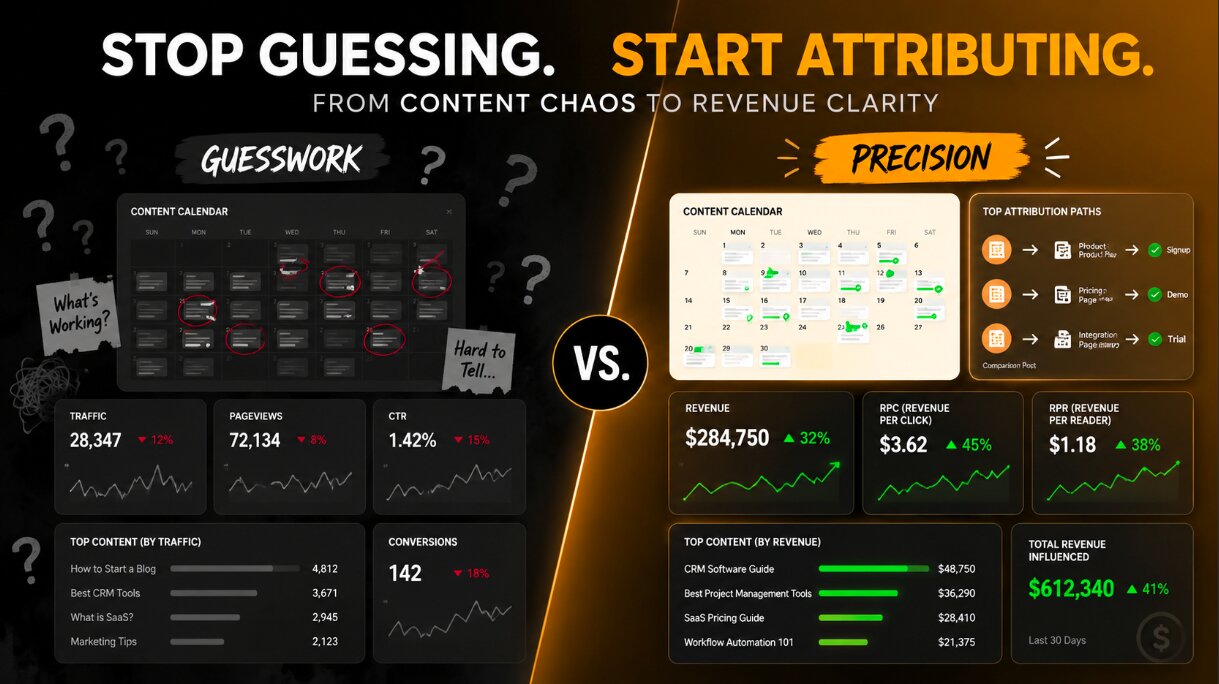
Most content calendars look organized on paper.
They have publishing schedules, keyword targets, traffic projections, and dozens of planned articles.
Yet six months later, nobody can answer a simple question:
Which pieces of content actually generated revenue?
That's the problem. Most content planning starts with traffic and hopes revenue follows. A Revenue-First Content Calendar starts with revenue and works backward.
The Problem: Most Content Calendars Optimize for Activity, Not Outcomes
Traditional content planning revolves around metrics that are easy to measure:
- Search volume
- Organic traffic
- CTR
- Social engagement
- Keyword rankings
These metrics create the illusion of progress.
A blog post can generate 20,000 visits and still contribute almost nothing to the business.
Meanwhile, another post with 500 visits may drive qualified leads, customers, and recurring revenue.
The enemy isn't low traffic.
The enemy is poor attribution.
When you can't connect content performance to revenue, every content decision becomes educated guesswork.
Teams publish more content, hoping something works.
Founders approve bigger content budgets without knowing what's producing returns.
The result is a calendar filled with activity but disconnected from business outcomes.
The Core Insight: Revenue Should Decide Your Content Priorities
Most marketers ask:
"What topics can generate traffic?"
Revenue-focused marketers ask:
"What topics generate customers?"
That single shift changes everything.
Instead of treating all content equally, you prioritize content based on business impact.
Think of it as the 80/20 rule applied to content strategy.
A small percentage of your content usually generates the majority of your revenue.
The goal is identifying that percentage and creating more of it.
This is where Revenue Per Click (RPC) becomes useful.
RPC measures how much revenue each click generates.
Instead of looking at traffic volume alone, you evaluate content based on revenue efficiency.
A post generating 1,000 visits and $2,000 in revenue is more valuable than a post generating 10,000 visits and $500 in revenue.
Traffic tells you what's popular.
Revenue tells you what's valuable.
How to Build a Revenue-First Content Calendar
Step 1: Start With Revenue Data, Not Keyword Tools
Most content planning begins inside SEO tools.
That's backward.
Begin by analyzing:
- Highest-converting content
- Best-performing acquisition channels
- Landing pages that influence sales
- Campaigns with strong RPC
Look for patterns.
Ask questions such as:
- What topics consistently generate customers?
- Which traffic sources produce buyers instead of browsers?
- What customer problems appear before a purchase?
Your best future content often leaves clues in your existing revenue data.
Step 2: Categorize Topics by Revenue Potential
Not every keyword deserves equal attention.
Create three content categories:
Revenue Drivers
Topics directly connected to buying decisions.
Examples:
- Product comparisons
- Solution-focused content
- Buyer guides
- Case studies
Revenue Influencers
Content that supports purchase decisions.
Examples:
- Educational content
- Industry trends
- Frameworks and methodologies
Traffic Content
Topics that attract visitors but rarely convert.
Examples:
- Broad informational keywords
- News-based content
- High-volume awareness topics
The goal isn't eliminating traffic content.
The goal is preventing it from dominating your calendar.
Step 3: Assign Revenue Scores to Every Content Idea
Before publishing anything, score each idea.
Consider:
- Purchase intent
- Historical conversion data
- Audience relevance
- Revenue potential
A simple scoring system works:
Content IdeaTraffic PotentialRevenue PotentialPriority
Product Comparison | Medium | High | High
Industry Guide | High | Medium | Medium
Trending News Topic | High | Low | Low
Case Study | Low | High | High
This prevents teams from chasing volume at the expense of outcomes.
Step 4: Build Content Around Customer Journeys
Most calendars are organized by publication dates.
Revenue-first calendars are organized by buying journeys.
Map content across stages:
Awareness
Help prospects understand the problem.
Consideration
Show possible solutions and approaches.
Decision
Provide proof, comparisons, and purchase confidence.
The closer content aligns with actual buying behavior, the easier it becomes to connect content performance to revenue.
Step 5: Measure Revenue, Not Just Traffic
Publishing content isn't the finish line.
Measurement is where the real advantage appears.
Track:
- Revenue Per Click (RPC)
- Lead-to-customer rates
- Assisted conversions
- Revenue by content asset
- Revenue by distribution channel
This creates a feedback loop.
The content generating revenue gets expanded.
The content generating attention but not revenue gets deprioritized.
Over time, your calendar becomes increasingly precise.
Traffic-First vs Revenue-First Content Planning
Traffic-First Calendar | Revenue-First Calendar
Optimizes for visits | Optimizes for revenue
Prioritizes search volume | Prioritizes customer value
Measures rankings | Measures revenue impact
Focuses on publishing frequency | Focuses on business outcomes
Relies on assumptions | Relies on attribution data
The difference isn't subtle.
One approach creates content.
The other creates growth.
Where Linkorio Fits In
Building a revenue-first content calendar requires accurate attribution.
That's difficult when you're relying on basic analytics that stop at clicks and traffic.
Linkorio helps marketers track which links, campaigns, content assets, and channels generate actual revenue using Revenue Per Click (RPC).
Instead of guessing which content contributes to sales, you can see exactly where revenue originates and use that data to plan future content with confidence.
Conclusion
Most content calendars are built around assumptions.
They assume traffic leads to customers.
They assume rankings lead to growth.
They assume more content creates better results.
A Revenue-First Content Calendar replaces assumptions with attribution.
When revenue becomes the metric guiding content decisions, planning gets simpler, priorities become clearer, and content turns into a measurable growth channel instead of a publishing exercise.
The future of content strategy isn't creating more content.
It's creating more of the content that makes money.