
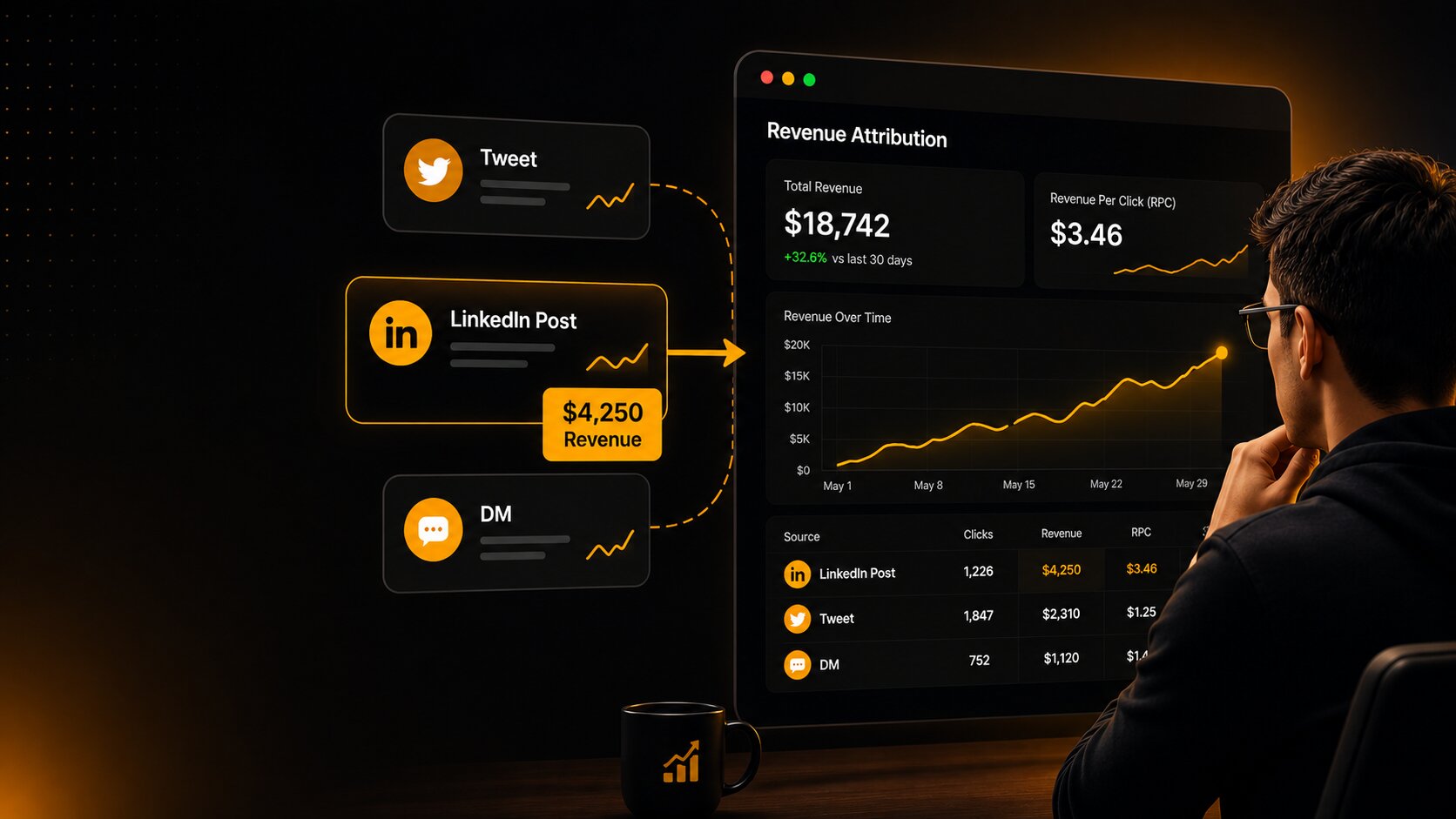
Most solopreneurs think the solution to growth is publishing more content.
More Tweets. More LinkedIn posts. More emails. More videos.
But there's a problem: most founders can't answer a simple question:
Which exact piece of content made me money?
That's where attribution for solopreneurs breaks down. You can see clicks, traffic, impressions, and engagement—but when revenue shows up, the connection often disappears.
If you don't know which content generated revenue, you're not making marketing decisions. You're guessing.
Why Attribution Is Broken for Solopreneurs
Most analytics tools were built to measure traffic, not revenue.
They'll tell you where visitors came from. They'll show page views, sessions, bounce rates, and click-through rates.
What they won't tell you is:
Which Tweet generated a customer?
Which LinkedIn post drove the sale?
Which DM conversation led to revenue?
That's the gap.
Last-Click Attribution Misses Reality
Most tools rely on last-click attribution.
A customer might discover you through a Tweet, read your newsletter a week later, click a LinkedIn post, then finally buy after visiting your website directly.
The final visit gets credit.
The content that actually influenced the purchase gets ignored.
As a result, founders often invest in the wrong channels because the attribution model rewards the final click instead of the content that created demand.
Dark Social Is Invisible
Some of the most valuable customer journeys happen in places analytics can't see.
People:
- Forward emails
- Share links in Slack groups
- Send recommendations through WhatsApp
- Copy and paste URLs into private chats
- Share content inside communities
This is often called dark social.
Traditional analytics tools struggle to attribute these interactions correctly, which means revenue appears disconnected from the content that started the conversation.
DMs Are Revenue Channels Nobody Tracks
For many consultants, creators, coaches, and SaaS founders, sales happen in direct messages.
Someone reads a post.
They reply.
A conversation starts.
A deal closes.
Yet most analytics systems have no way to connect that sale back to the original content that triggered the interaction.
Vanity Metrics Create False Confidence
This is where things become dangerous.
A post gets:
- 100,000 impressions
- 2,000 likes
- 500 shares
Everyone assumes it's a success.
But did it generate revenue?
Maybe.
Maybe not.
Meanwhile, a post with 500 impressions could generate three customers.
Without revenue attribution, both posts look completely different from reality.
The enemy isn't poor performance.
The enemy is guessing.
Attribution for Solopreneurs Doesn't Need Enterprise Software
When people hear "revenue attribution," they often imagine complicated dashboards, customer data platforms, and enterprise analytics systems.
Most solopreneurs don't need any of that.
They need one thing:
Content-level revenue visibility.
They need to know:
- Which Tweet generated sales
- Which LinkedIn post produced customers
- Which email drove revenue
- Which DM converted into a purchase
Instead of tracking channels, track the links inside those channels.
Every piece of content becomes measurable.
Every click becomes attributable.
Every sale becomes connected to the content that generated it.
Why Revenue Attribution Matters More Than Traffic
Traffic is a proxy.
Revenue is the outcome.
Traffic can increase while revenue stays flat.
Engagement can explode while sales decline.
A viral post can generate thousands of visitors and zero customers.
That's why revenue attribution is more valuable than traditional content metrics.
Revenue answers the only question that ultimately matters:
Did this content generate money?
The Missing Metric: Revenue Per Click (RPC)
Once revenue is connected to individual links, a more useful metric becomes available:
Revenue Per Click (RPC)
Formula:
RPC = Total Revenue ÷ Total Clicks
Example:
- 100 clicks
- $1,000 revenue
RPC = $10
Another example:
- 1,000 clicks
- $500 revenue
RPC = $0.50
The second piece of content generated more traffic.
The first piece of content generated more value.
RPC reveals the difference immediately.
How to Know Exactly Which Content Closed the Sale
Step 1 — Create Unique Tracking Links for Every Channel
The first step is creating unique links for every distribution point.
That means separate links for:
- Tweets on X
- LinkedIn posts
- Email newsletters
- DMs
- Slack communities
- Discord communities
- Forum posts
Avoid reusing the same URL everywhere.
If every channel uses the same destination link, attribution becomes impossible.
Each content asset should have its own trackable identifier.
For example:
- Newsletter Link A
- LinkedIn Post B
- Tweet C
- DM Link D
Now every click can be traced back to a specific source.
Step 2 — Connect Revenue Back to Each Link
This is where traditional analytics tools begin to fall short.
Google Analytics can tell you where visitors came from.
UTM parameters can identify campaign sources.
Bitly can count clicks.
None of them were designed to answer:
How much revenue did this specific link generate?
Link-level revenue attribution connects purchases directly to the originating link.
Instead of measuring traffic activity, you measure business outcomes.
Now you can see:
- Revenue generated by a Tweet
- Revenue generated by a LinkedIn post
- Revenue generated by an email
- Revenue generated by a DM
The content becomes accountable.
Step 3 — Measure Revenue Per Click (RPC)
Once revenue attribution is working, calculate RPC for every link.
Formula:
RPC = Revenue ÷ Clicks
Example:
Content | Clicks | Revenue | RPC
Tweet A | 500 | $2,500 | $5.00
LinkedIn Post B | 200 | $3,000 | $15.00
Newsletter C | 1,000 | $2,000 | $2.00
Most marketers would focus on Newsletter C because it generated the most clicks.
Revenue attribution reveals a different story.
LinkedIn Post B generated the highest revenue efficiency.
That's where more effort should go.
Step 4 — Double Down on Revenue-Generating Content
Most content strategies optimize for engagement.
That's a mistake.
Engagement doesn't pay salaries.
Revenue does.
Once you know which content produces the highest RPC, you can:
- Publish more of the winning formats
- Expand successful topics
- Prioritize high-performing channels
- Stop investing in content that attracts attention but not customers
The goal isn't more content.
The goal is more profitable content.
Content-Level Attribution vs Traditional Analytics
Metric | What It Tells You | What It Doesn't Tell You
Impressions | Reach | Revenue
Clicks | Interest | Revenue
CTR | Engagement | Revenue
Traffic | Visitors | Revenue
Revenue Per Click | Revenue efficiency | —
The problem with impressions, clicks, CTR, and traffic is that they're all upstream metrics.
They suggest potential.
They don't confirm outcomes.
Revenue Per Click connects content performance directly to business results.
That's why it becomes a far more useful decision-making metric.
Where Linkorio Fits
Linkorio helps founders move beyond traffic reports and basic analytics by connecting revenue directly to the links they share.
Instead of stopping at clicks, Linkorio allows you to generate trackable links, attribute revenue to specific content, measure Revenue Per Click, and discover which Tweets, LinkedIn posts, emails, DMs, and community shares actually generate sales.
For founders focused on growth, the goal isn't tracking more data. It's identifying which content creates revenue and doing more of it.
Conclusion
Most solopreneurs don't have a content problem.
They have an attribution problem.
They're measuring impressions, clicks, engagement, and traffic while the most important signal remains hidden.
Stop asking:
"Which post got the most engagement?"
Start asking:
"Which post generated the most revenue?"
Once you can track which content drives sales, every marketing decision becomes clearer—and every piece of content becomes part of a more predictable growth engine.